

Which earth pressure module do I need?
The Lateral Earth Pressure family has seven modules. They answer one question, the pressure of the ground on a wall, for different walls, grounds and actions. Pick the one that matches your wall.
| Your situation | Module |
|---|---|
| A wall that does not move, such as a basement wall or a braced wall, with a level backfill | At rest (K₀) |
| A vertical wall that yields, with a level backfill: active or passive pressure | Rankine |
| A vertical or inclined back with a sloping backfill, by Rankine’s approach | Rankine, sloping backfill |
| A wall with friction on its back, a battered back or a sloping backfill, by the wedge theory | Coulomb |
| The active force on a wall in an earthquake | Mononobe–Okabe |
| The passive resistance on a curved failure surface, with friction on a rough wall | Passive, log spiral |
| The passive force on a wall in an earthquake | Passive, earthquake |
The seven manuals
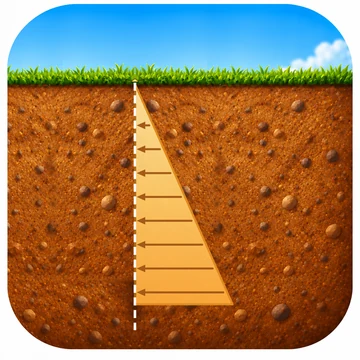 At rest (K₀)Earth pressure behind a wall that does not move.
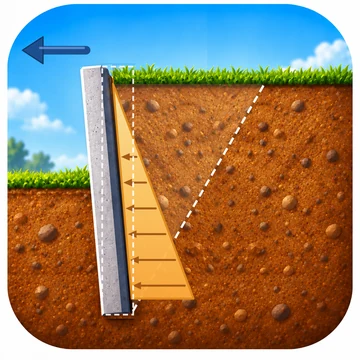 RankineActive and passive pressure on a vertical wall with level ground.
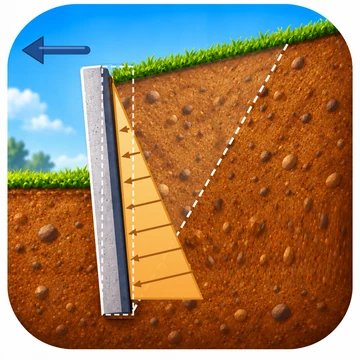 Rankine, sloping backfillRankine pressure under an inclined backfill.
 CoulombWedge theory with wall friction and a battered wall.
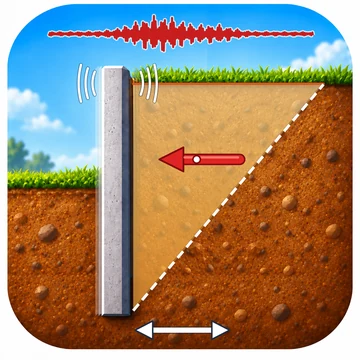 Mononobe–OkabeThe active force on a wall during an earthquake.
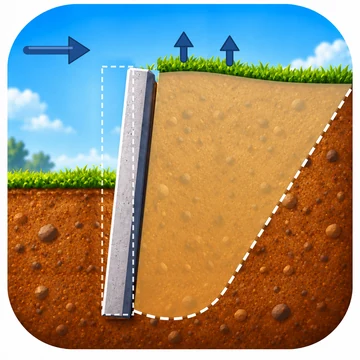 Passive, log spiralPassive resistance on a curved failure surface.
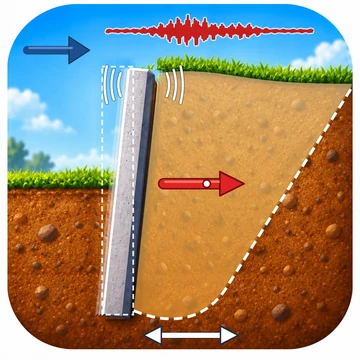 Passive, earthquakeThe passive force on a wall during an earthquake.
Each manual follows the same plan: what the module calculates, what you need before you start, a quick start, the screen, every input, the results, the report, a worked example you can reproduce, a table of how each input changes the answer, the messages the module gives, and answers to common questions.
The methods side by side
| Module | Pressure | Methods |
|---|---|---|
| At rest (K₀) | At rest | Jaky, Mayne & Kulhawy, Massarsch, Sherif, or a value you give |
| Rankine | Active or passive | Rankine |
| Rankine, sloping backfill | Active, sloping backfill | Chu (1991), Mazindrani & Ganjali (1997) |
| Coulomb | Active or passive | Coulomb’s wedge theory with trial wedges |
| Mononobe–Okabe | Active, earthquake | Mononobe–Okabe, Seed & Whitman |
| Passive, log spiral | Passive | Critical log-spiral trial wedge; Terzaghi & Peck, Shields & Tolunay, Zhu & Qian for comparison |
| Passive, earthquake | Passive, earthquake | Subba Rao & Choudhury (2005) |
A typical earth pressure check in order
- Choose the module
Decide whether the wall is held, free to yield, battered or sloping, and whether the action is static or an earthquake.
- Describe the ground
Enter the layers, the water table and the surcharge, and the wall geometry the module asks for.
- Analyze and read the diagram
Press Analyze. Read the coefficient of each layer, the pressure diagram, the resultant and the height at which it acts.
- Compare and report
Run a second module on the same wall to compare, for example Rankine and Coulomb, then save a report from each run with the cover filled in.
Frequently asked questions
What is the difference between at-rest, active and passive earth pressure?
At-rest pressure acts on a wall that does not move. Active pressure acts when the wall yields away from the soil, and passive pressure when it is pushed into the soil. The At rest, Rankine and Coulomb modules give each of them.
Which module do I use for the earth pressure behind a basement wall?
Use At rest (K₀), which takes a layered level backfill, a water table and a surcharge.
Should I use Rankine or Coulomb?
Use Rankine for a vertical wall with a level backfill. Use Coulomb when the back of the wall has friction, is battered or the backfill is sloping. Run both and compare the resultants.
How do I calculate earth pressure in an earthquake?
Use Mononobe–Okabe for the active force and Passive, earthquake for the passive force. Both take the horizontal and vertical seismic coefficients.
Which module gives the passive pressure on a curved failure surface?
Passive, log spiral, which finds the critical log-spiral trial wedge for a rough wall.
Do the modules include a water table and a surcharge?
Yes. Every module takes layered soil, a water table and a surcharge.