

Which sheet-pile module do I need?
The Sheet-Pile Walls family has three modules. All of them build the pressure diagram on the wall, find the depth of embedment, give the maximum moment and check the steel section. They differ in the ground they take and in the extra cases and checks they add. Pick the one that matches your profile.
| Your ground and wall | Module |
|---|---|
| A wall driven into sand, free-standing or held by anchors, with the water on both faces | Sheet pile in sand |
| A wall in undrained clay, with the tension crack above the dredge line and the net pressure of 4cu below it | Sheet pile in clay |
| A profile of sand and clay layers in any order, with one to four rows of inclined anchors, their free and bond lengths, and the short-term and long-term cases of the clay | Anchored sheet pile on layered soil |
The three manuals
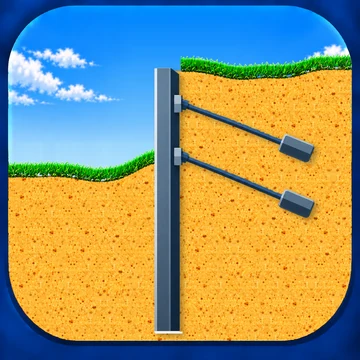 Sheet pile in sandA cantilever or anchored wall driven into sand.
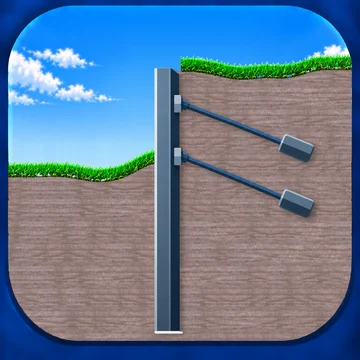 Sheet pile in clayUndrained clay above and below the dredge line, with the tension crack.
 Anchored sheet pile on layered soilSand and clay layers, up to four inclined anchor rows, short- and long-term.
Each manual follows the same plan: what the module calculates, what you need before you start, a quick start, the screen, every input section by section, the choices that decide the margin, the results, the report, a worked example you can reproduce, a table of how each input changes the answer, the messages the module gives, and answers to common questions.
What each module takes, side by side
| In sand | In clay | Anchored, layered | |
|---|---|---|---|
| Soil | Sand in up to four layers | Undrained clay in up to four layers | Up to six layers, each sand or clay |
| Wall | Cantilever, or up to four anchor rows | Cantilever, or up to four anchor rows | Cantilever, or one to four rows of inclined anchors |
| Special to it | Sloping surface | Tension crack, water-filled or dry | Short- and long-term cases, anchor free and bond lengths |
| Also takes | Water on both faces, uniform, strip and point loads, earthquake | Water on both faces, six surcharges, earthquake, bottom heave | Water on each face, uniform, strip and point loads, earthquake, bottom heave, displacement |
The three modules take water at its own level on each face of the wall.
A typical sheet-pile design in order
- Choose the module
Pick the one that matches the ground and open its manual for the fields.
- Describe the ground and the wall
Enter the layers, the water, the retained height and, if the wall is anchored, the anchor rows.
- Choose the margin
Decide the route to the embedment and give the loads on the ground and the earthquake if they apply.
- Choose the steel and the code
Pick the grade and the section and the design code, then press Analyze.
- Read and report
Read the embedment, the anchor forces, the maximum moment and the utilisation, then save a report with the cover filled in.
Frequently asked questions
How do I design a sheet-pile wall with GeoTerva?
Open the module for the ground, Sheet pile in sand, Sheet pile in clay or Anchored sheet pile on layered soil. Enter the layers, the water and the wall, choose the route to the embedment and the steel, press Analyze, and read the embedment, the maximum moment, the anchor forces and the section check.
Which module do I use for a wall in sand and clay together?
Anchored sheet pile on layered soil. It takes any profile of sand and clay layers, each layer as drained sand or as clay in the short and the long term, and it works as a cantilever or with anchors.
Which standard does the section check follow?
The sheet pile is checked to EN 1993-1-1 or to AISC 360-22; you choose the design code in the last section of the Model tab.
Can I give the depth of embedment myself?
Yes. The embedment can be calculated by the program or given; a given depth is verified.
How many anchor rows can a wall have?
Each of the three modules takes a cantilever wall or a wall held by up to four anchor rows. The anchored module on layered soil takes the rows as inclined ground anchors and gives their free and bond lengths.
Does the water table matter?
Yes. The modules take the water at its own level on each face of the wall, and the water in the tension crack of the clay.