

Which pile module do I need?
The Piles family has five modules. Pick the one that matches the question you are asking about the pile.
| Your question | Module |
|---|---|
| What axial load can one pile in sand carry, at the tip and along the shaft? | Pile in sand |
| What axial load can one pile in clay carry, by the α, λ or β method? | Pile in clay |
| What axial load can one pile carry through sand and clay layers in any order? | Pile on layered soil |
| How far does a pile deflect under a sideways load, and what are the moment and shear along it? | Pile under lateral load |
| What is the load on every pile of a cap, the capacity of the group, its settlement and the response of its rows to a lateral load? | Pile group |
The five manuals
 Pile in sandPoint and skin resistance of a single pile driven into sand.
 Pile in clayPoint and skin resistance of a single pile in undrained clay.
 Pile on layered soilSand and clay layers along the shaft, each with its own method.
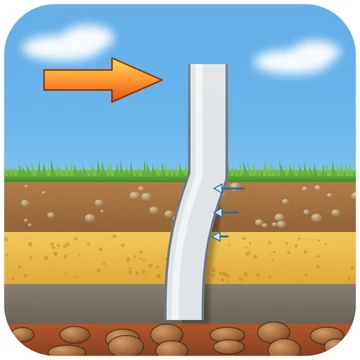 Pile under lateral loadDeflection, moment and shear along a pile in layered ground, by p–y curves.
 Pile groupThe load on every pile, the group effect, the settlement and the lateral response of a group in layered ground.
Each manual follows the same plan: what the module calculates, what you need before you start, a quick start, the screen, every input, the methods, the results, the report, a worked example you can reproduce, a table of how each input changes the answer, the messages the module gives, and answers to common questions.
The methods side by side
| Module | Resistance or response | Methods |
|---|---|---|
| Pile in sand | Point bearing | Meyerhof (1976), Vesic (1977), Coyle & Castello (1981) |
| Pile in sand | Skin friction | K–δ method, Coyle & Castello (1981), layer by layer |
| Pile in clay | Point bearing | Meyerhof, Vesic, Reese & O’Neill (drilled shafts) |
| Pile in clay | Skin friction | α method, λ method (driven piles), β method, layer by layer |
| Pile on layered soil | Point bearing and skin friction | The method of the soil the tip stands in; each layer by the method for its own soil |
| Pile under lateral load | Soil reaction | p–y curves: API sand, Matlock soft clay, or an elastic subgrade reaction; static or cyclic |
| Pile group | Group effect | Rigid-cap load distribution; efficiency by Converse–Labarre, Kishida–Meyerhof and AASHTO; block failure layer by layer |
| Pile group | Settlement | Elastic (Vesic) and consolidation (2:1 from 2L/3) |
| Pile group | Lateral group effect | p-multipliers (AASHTO, Rollins et al.) on the p–y curves |
A typical pile design in order
- The axial capacity of one pile
Run Pile in sand, Pile in clay or Pile on layered soil for the ground you have. Compare two methods for the point and for the shaft and keep each run with a quick save.
- The lateral response of one pile
Run Pile under lateral load with the same ground and pile. Read the head deflection and the largest moment, and the load at an allowable deflection.
- The group
Run Pile group with the layout of the cap. It reuses the single-pile methods layer by layer and adds the load on every pile, the group effect, the settlement and the lateral response of the rows.
- The reports
Save a report from each run. Fill in the cover so that the project, the client and the checker are named on it.
Frequently asked questions
How do I calculate pile capacity with GeoTerva?
Open the module that matches the ground, Pile in sand, Pile in clay or Pile on layered soil. Enter the layers, the pile and the methods, press Analyze, and read the point bearing, the skin friction, the ultimate capacity and the allowable capacity, with every step of the working.
What is the difference between a driven, a bored and a jacked pile in the modules?
Installation decides which methods are open and what the shaft coefficients are filled in with. Methods read from driven piles, such as Coyle & Castello in sand and the λ method in clay, are refused for a bored pile and allowed with a caution for a jacked one. A bored pile gets an at-rest coefficient in sand and a drilled-shaft adhesion factor in clay.
Which module gives the settlement of a pile?
The Pile group module gives the elastic settlement of the pile and the group, and the consolidation settlement of the clay below 2L/3. The axial modules for one pile give the capacity.
Can I analyse a pile in sand and clay together?
Yes. Pile on layered soil takes any stack of sand and clay layers, each typed on its own, and works out the shaft resistance of each layer by the method for its soil and the point bearing by the method for the soil the tip stands in.
Does GeoTerva check lateral loads on piles?
Yes. Pile under lateral load gives the deflection, rotation, moment, shear and soil reaction along a single pile, by p–y curves or an elastic subgrade reaction. The Pile group module adds the p-multipliers of the rows.
How many layers can a pile model have?
Up to eight layers in every module of the family.