

What the module calculates
Infinite slope gives the factor of safety of a long, uniform slope against sliding on a plane parallel to the ground, at the vertical depth H below it. The slope is taken as so long that its ends play no part, so every point of the plane is in the same state and one strip of the sliding mass stands for all of it. The factor of safety is the shear strength of the soil on the plane over the shear stress that the weight of the strip puts on it:
σv is the total vertical stress at the plane, σ′ = σ − u is the effective normal stress and u the pore water pressure on the plane. For an undrained clay the strength is cu alone (φu = 0, total stress).
What you can describe
- A slope angle β and the depth H of the failure plane, measured vertically.
- One soil above the plane: Drained — c′, φ′ (effective strength, long term) or Undrained — cᵤ, φᵤ = 0 (a clay in the short term).
- Pore water on the plane, in a drained analysis: None, a Water table, seepage parallel to the slope at the depth zw, or a Pore pressure ratio ru.
- A pseudo-static earthquake with kh and kv that you give.
- The required factor of safety, which decides the verdict.
What you get
- The factor of safety with its verdict (OK, OK, near the limit or NOT OK), and the stresses behind it: σ, u, σ′, τ and τf.
- The depth Hreq at which the factor of safety falls to the required value, the steepest slope angle βreq that keeps it, and the critical depth Hcr where it falls to 1.
- With water, the same slope without pore pressure and with the water at the ground surface.
- With an earthquake, the earthquake factor of safety, the yield coefficient ky (the kh at which the factor of safety falls to 1) and its own Hreq and βreq.
- Three views (the section, the stresses on the plane, charts), a step-by-step working and a PDF or Word report.
What belongs to the other module
A slope of finite length, with layers, a groundwater line, loads, reinforcement and a search for the critical slip circle belongs to Slope stability. This module is for the shallow sheet that slides on a plane parallel to the ground.
Before you start: what you need
| What and where from | Notes |
|---|---|
| The slope angle β Survey or design | From 0.1° to 70°. The failure plane has the same angle. |
| The depth H of the plane Borehole logs, observed slips | Measured vertically, from the ground down to the plane. The thickness at right angles to the slope is H cos β. |
| The unit weight γ Tests | Of the soil as it lies. With a water table it is the unit weight above the table. |
| The strength: c′ and φ′, or cu Tests or correlations | Effective strength for the long term; cu for a clay in the short term. |
| The saturated unit weight γsat Tests | Only with a water table; it must be above 9.81 kN/m³. |
| The water Piezometers, design assumption | A water table parallel to the slope, or a ratio ru. |
| kh and kv Your design criteria | The module takes them as you enter them. |
| The required factor of safety Your design criteria | Default 1.50 (static) and 1.10 (earthquake). |
Quick start in eight steps
- Open the module and choose the units
Open Infinite slope from the Slope Stability family and pick SI · kN, SI · tf or US in the header.
- Enter the slope
In Slope, type the slope angle β and the depth H of the failure plane, then press Next.
- Describe the soil
In Soil, choose the strength (drained or undrained) and enter γ with c′ and φ′, or cu.
- Give the pore water
In Pore water, choose None, a water table or ru. With a table the soil section also asks for γsat.
- Add an earthquake if you need one
In Earthquake, choose Pseudo-static and enter kh and kv.
- Set the required factor of safety
In Analysis Settings, enter FSreq (and FSreq,eq with an earthquake).
- Press Analyze
Press Analyze. The inputs lock and the bar reads Analysed — the factor of safety calculated. Open Results; the Stresses and Charts views fill in.
- Take the working and the report
Calculations shows the steps with your numbers; Report saves a PDF or a Word file.
The screen: three views of the slope
The layout is the one every GeoTerva module shares, described in the workspace guide. The drawing has three views, chosen with the buttons above it:
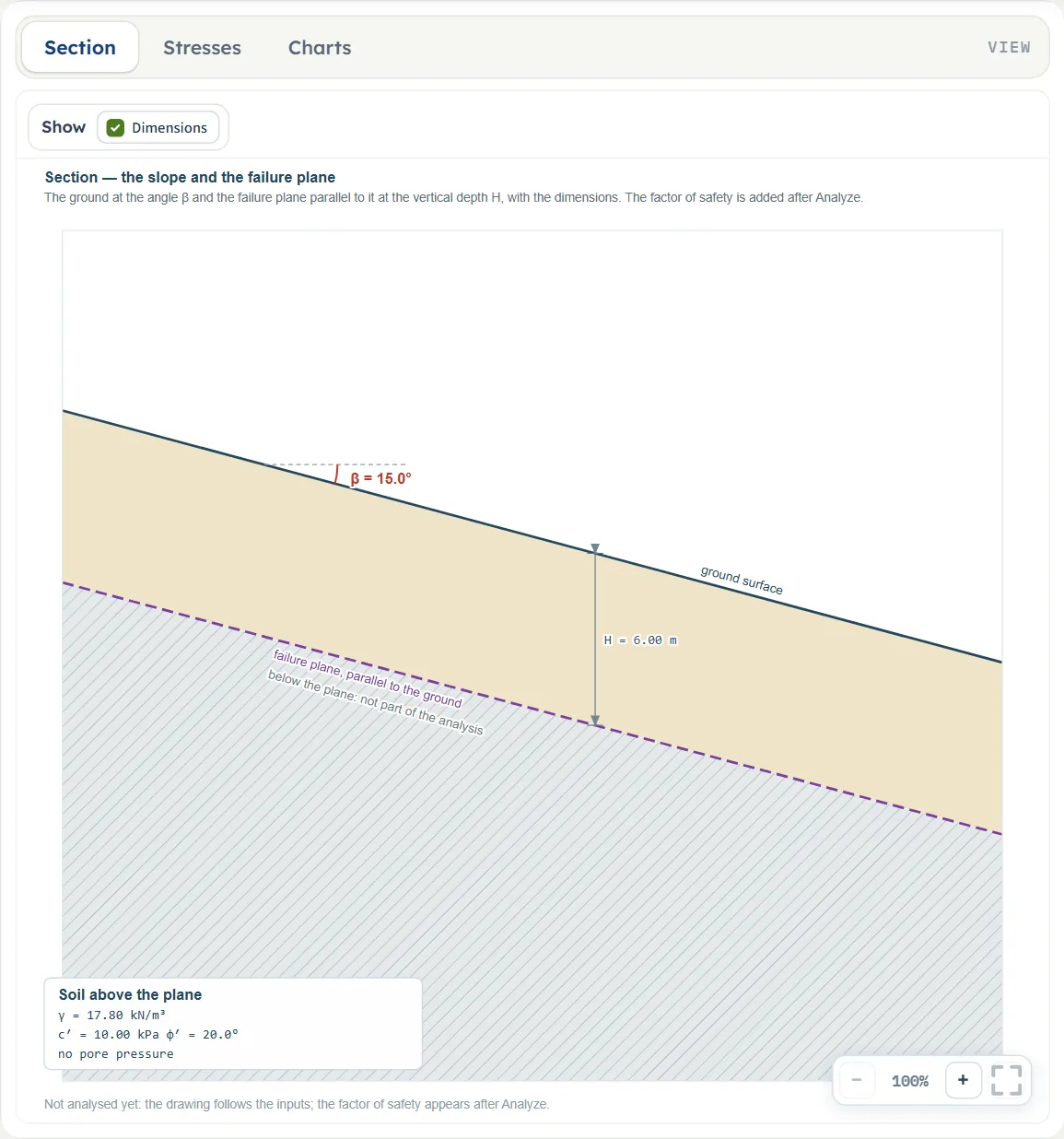
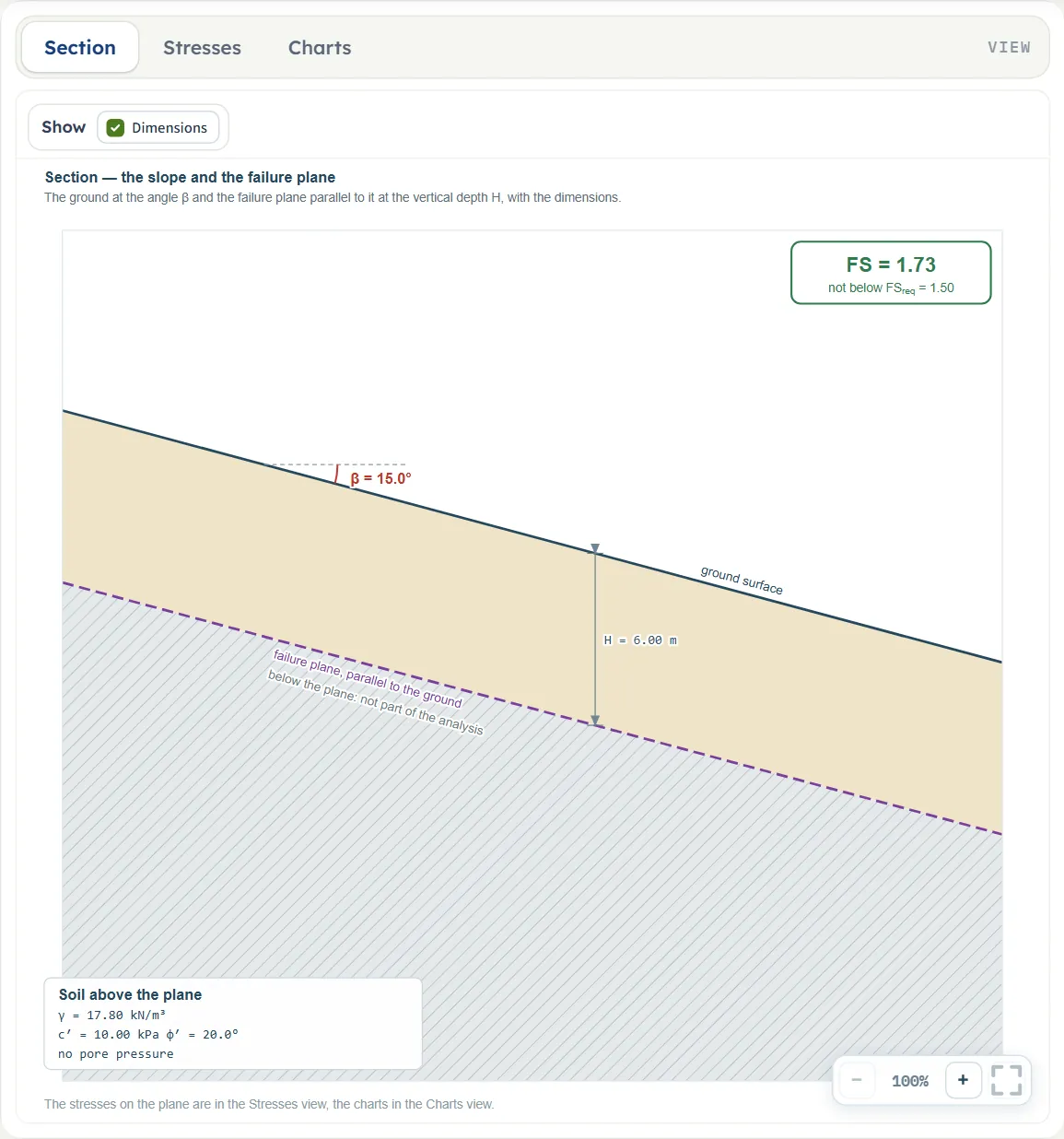
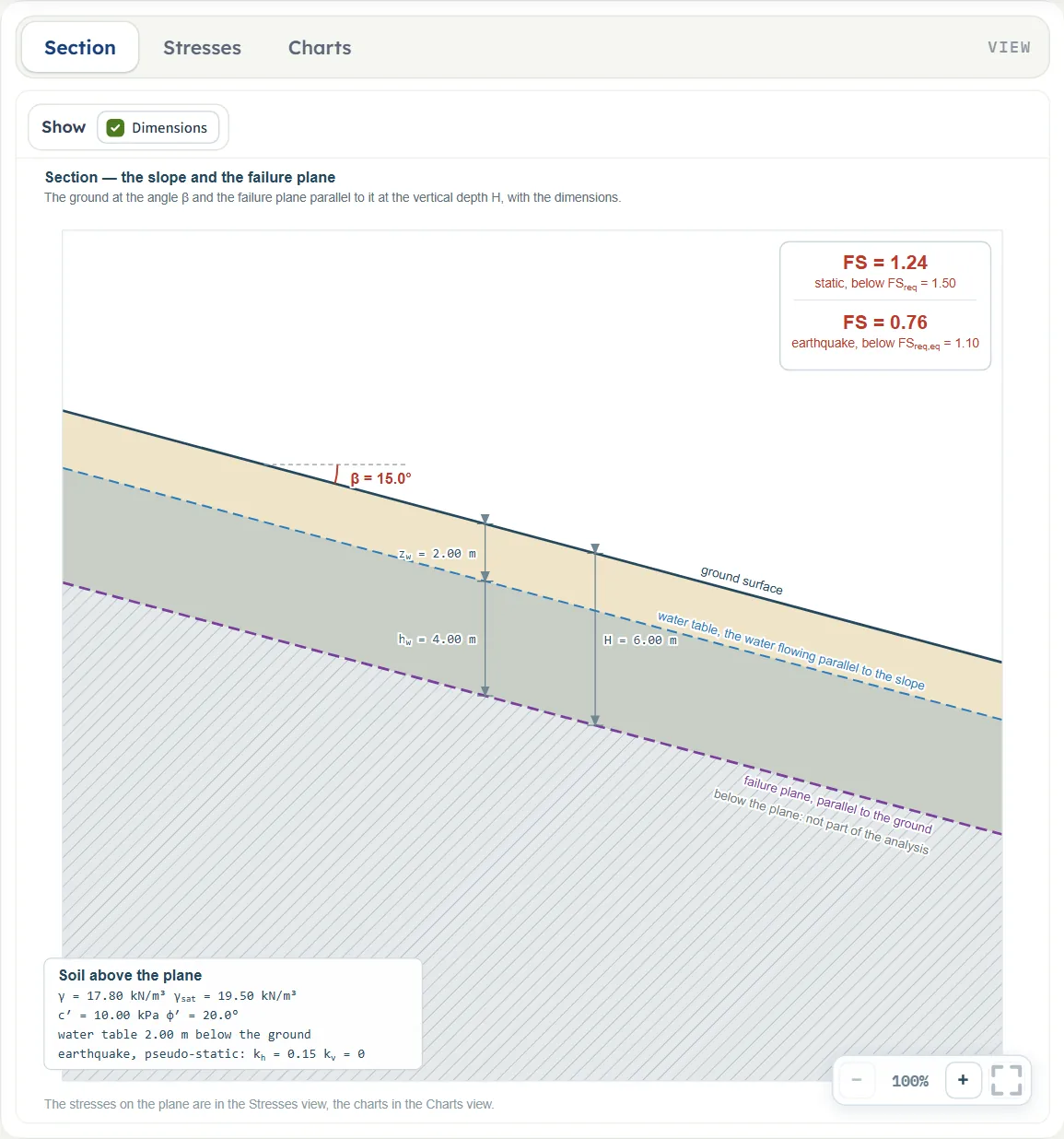
- Section is the slope in section: the ground surface at the angle β, the failure plane parallel to it, the depth H, the water table with zw and hw when there is one, the soil box (γ, c′, φ′, the pore water, the earthquake) and, after Analyze, the factor of safety in a box at the top right (two boxes with an earthquake).
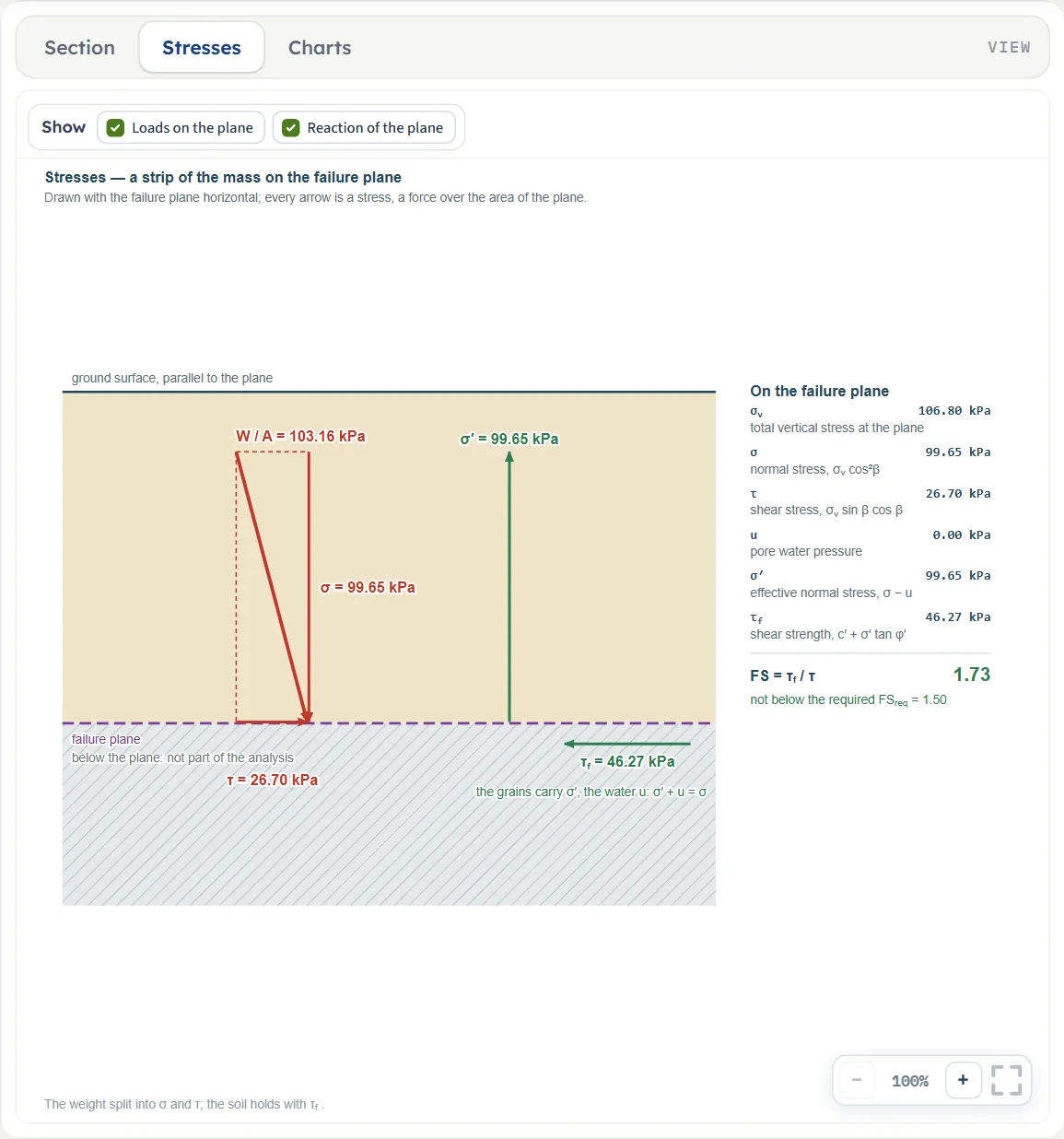
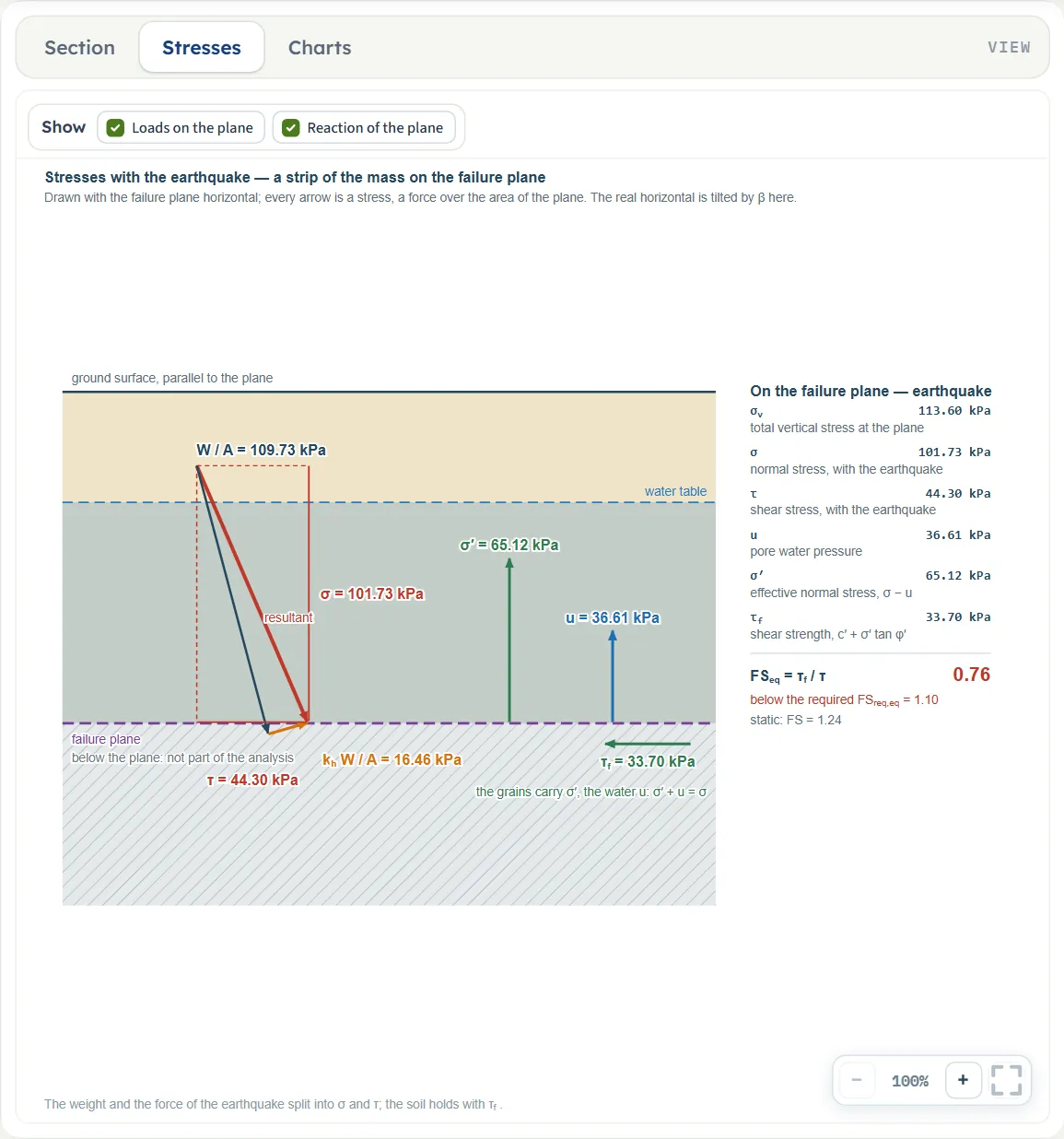
- Stresses draws a strip of the mass with the failure plane horizontal: its weight W/A, the normal stress σ and the shear stress τ it puts on the plane and what the plane gives back, σ′, u and τf. A panel lists the values. With an earthquake the picture shows the earthquake case, with the horizontal force and the resultant.
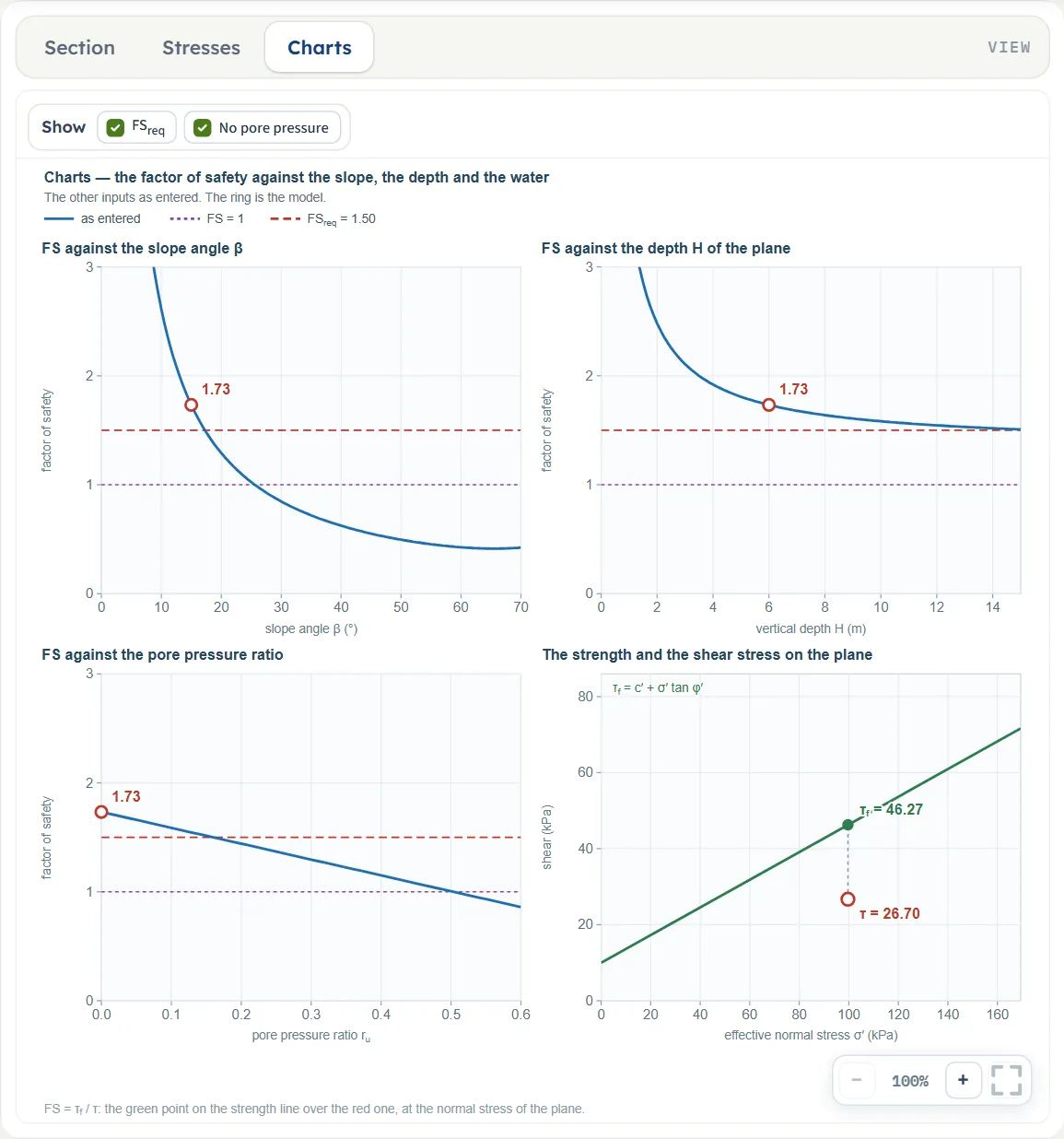
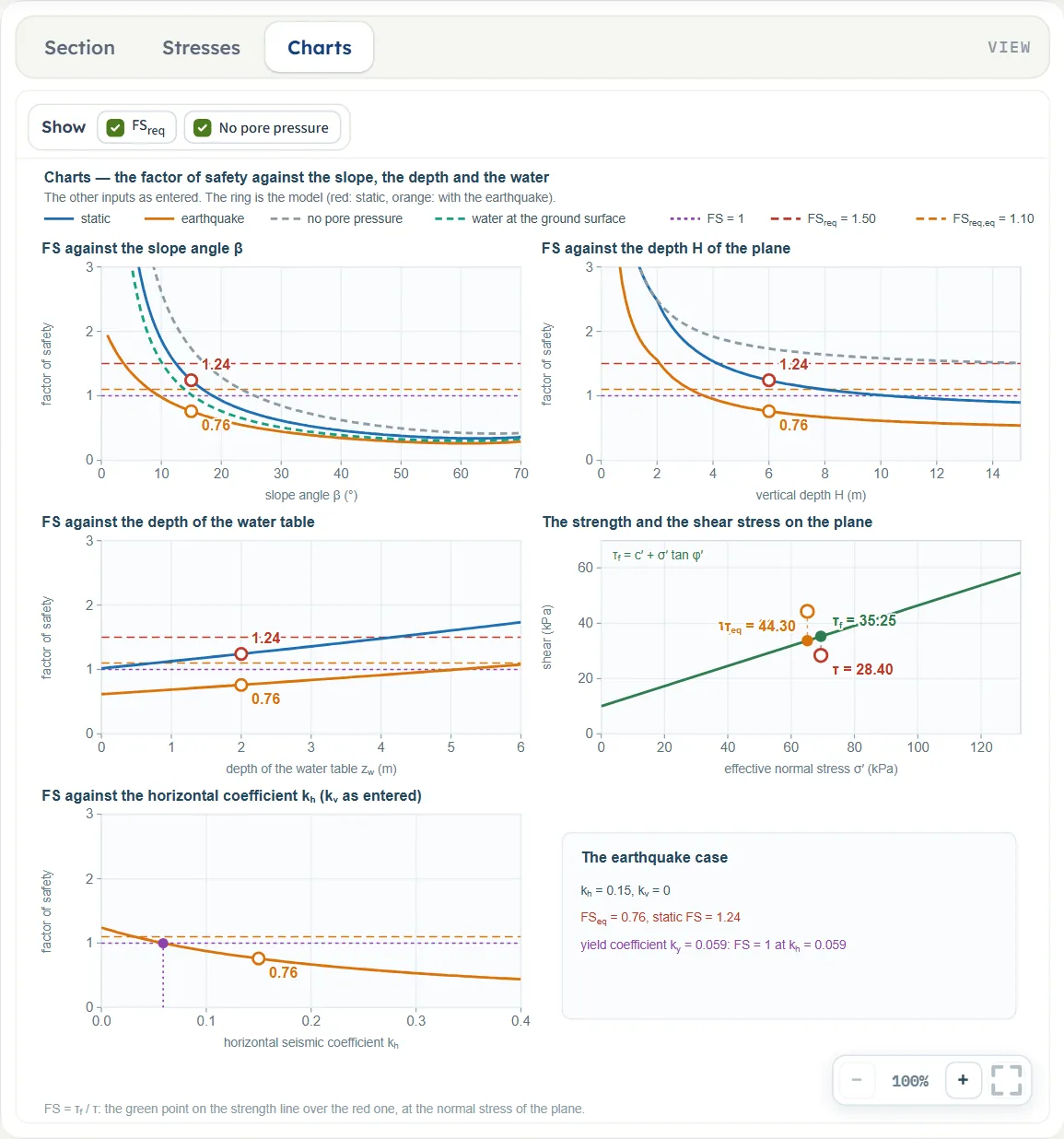
- Charts plots the factor of safety against the slope angle, the depth of the plane and the water (its depth, ru, or cu), and the strength line against the stresses. With an earthquake the earthquake case is a second line and a fifth chart gives the factor of safety against kh with the yield coefficient.
The Show chips
- Section: Dimensions shows or hides the dimension lines (H, and zw, hw with a water table).
- Stresses: Loads on the plane and Reaction of the plane show or hide the two sets of arrows.
- Charts: FSreq shows or hides the required-value lines and No pore pressure the dry curve.
Before Analyze the Stresses and Charts views are empty: the Stresses bar reads “The pressures and the resultant appear after Analyze” and the drawing says “The strip and its stresses appear after Analyze”.

Zoom, and nothing to drag
Each view has −, + and a fit button at its lower right corner; each click of + raises the zoom by about a third (100 %, 135 %, 182 %, 246 % and on to 800 %) and each click of − lowers it again to 100 %. Nothing on the drawing can be dragged: the slope, the plane and the water are set in the Model tab, and the drawing follows the inputs.
Entering the model, section by section
The Model tab has six sections: Model data, Slope, Soil, Pore water, Earthquake and Analysis Settings. Model data opens and closes on its own; the other five work as an accordion: opening one closes the previous one. Next and Back walk you through them and Analyze waits below. Defaults are shown in SI; units follow the system chosen in the header (m · ft, kN/m³ · pcf, kPa · psf).
Model data
The model name, Save to file…, Open file…, Quick Save… with its list, Load, Delete and Reset to defaults, as in the workspace guide. The section says every change is kept in this browser. After Analyze all inputs are locked until Edit inputs.

Slope
The ground is a plane at the angle β; the failure plane is parallel to it at the vertical depth H.
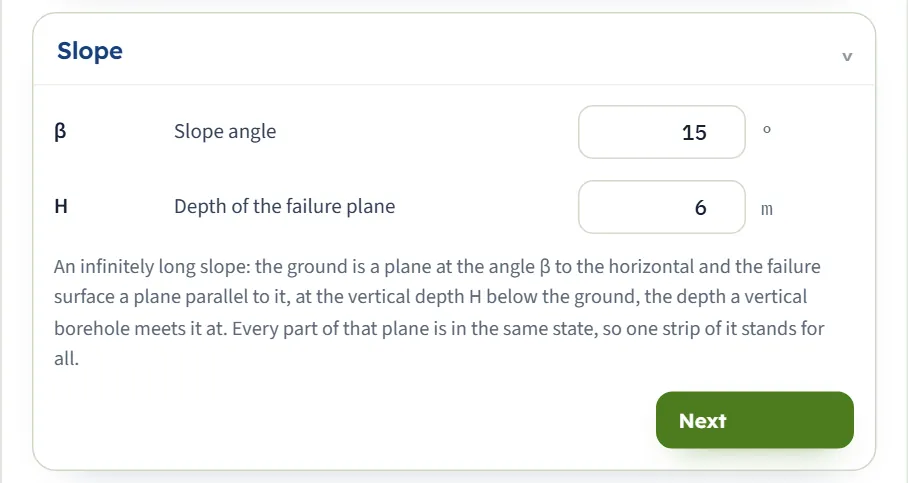
| Field and unit | Default | Accepted |
|---|---|---|
| Slope angle β ° | 15 | 0.1 to 70 |
| Depth of the failure plane H m · ft | 6 | 0.05 or more |
Soil
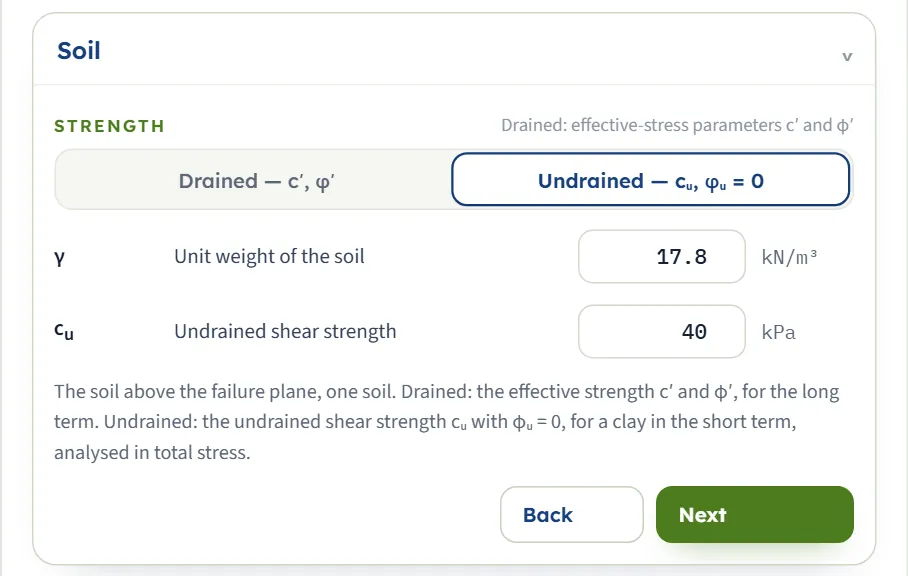
Two buttons choose the strength. The fields that apply to the choice appear under them.
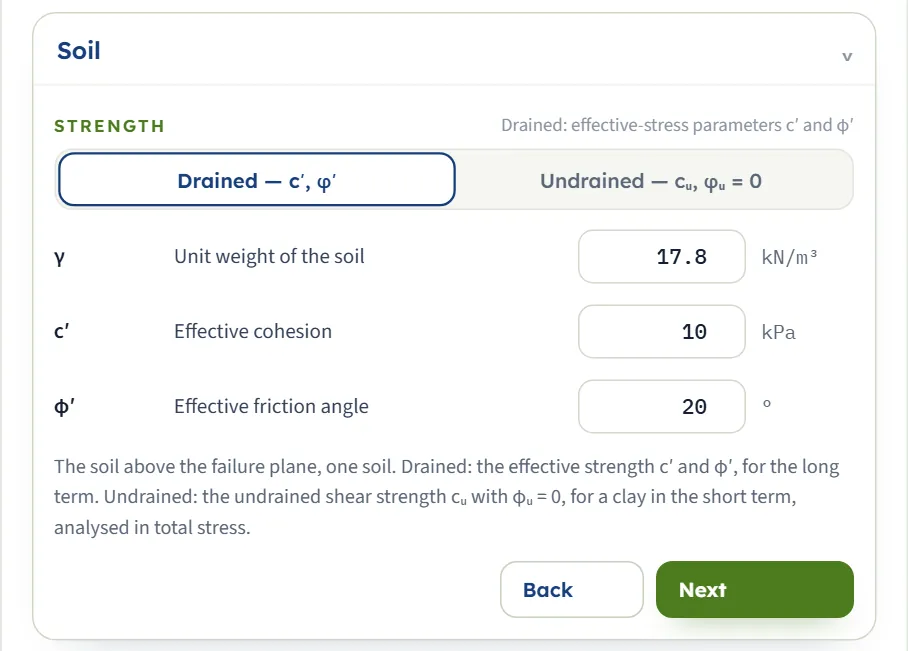
| Field and unit | Default | Shown when |
|---|---|---|
| Unit weight γ kN/m³ · pcf (1 or more) | 17.8 | always |
| Saturated unit weight γsat kN/m³ · pcf (1 or more) | 19.5 | water table |
| Effective cohesion c′ kPa · psf (0 or more) | 10 | drained |
| Effective friction angle φ′ ° (0 to 50) | 20 | drained |
| Undrained shear strength cu kPa · psf (0.1 or more) | 40 | undrained |
The unit weight γ is that of the soil above the water table; below it the saturated unit weight γsat is used. Choosing Undrained — cᵤ, φᵤ = 0 hides c′, φ′ and the Pore water choices: an undrained analysis is in total stress.
Pore water
Three buttons give the pore pressure on the plane (drained analyses only).
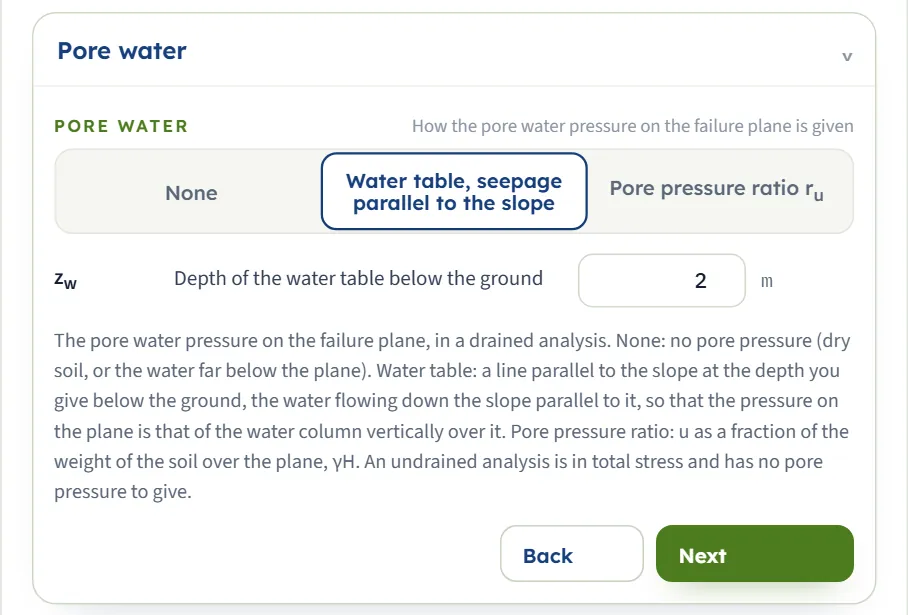
| Option, field, default |
|---|
| None no field; no pore pressure |
| Water table, seepage parallel to the slope Depth zw of the table below the ground, m · ft default 2; 0 or more |
| Pore pressure ratio ru Ratio ru default 0.25; 0 to 0.9 |
- Water table. A line parallel to the slope, the water flowing down the slope parallel to it, so the pore pressure on the plane is that of the water column vertically over it: u = γw hw cos²β, with hw = H − zw and γw = 9.81 kN/m³. zw = 0 is the water at the ground surface. A table at or below the plane puts no water on it.
- Pore pressure ratio. u = ru γ H, the way slope charts take the water; it uses γ for the whole column.
Earthquake
None gives the static analysis alone. Pseudo-static gives the static and the earthquake factors of safety side by side.
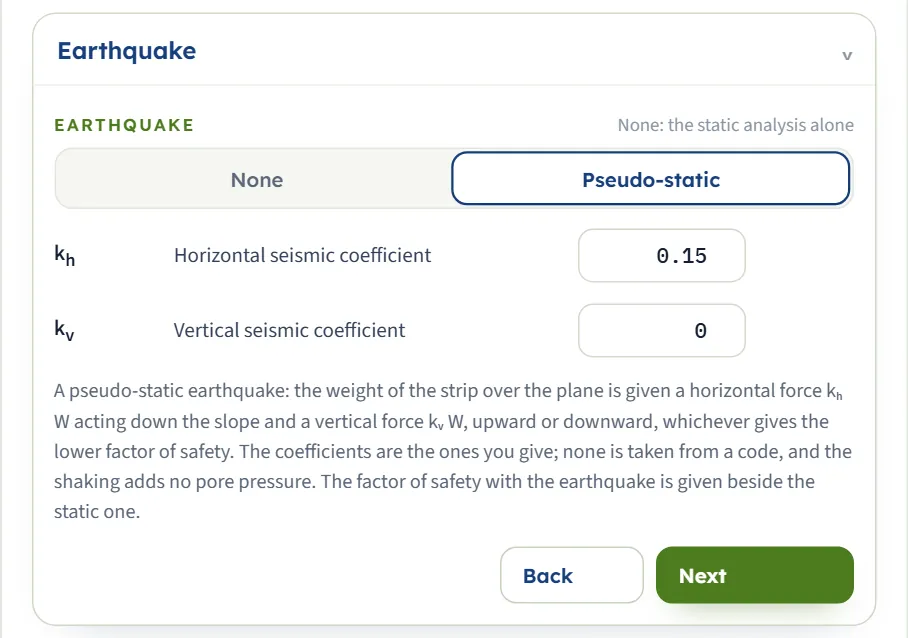
| Field and unit | Default | Accepted |
|---|---|---|
| Horizontal coefficient kh | 0.15 | 0 to 1 |
| Vertical coefficient kv | 0 | 0 to 0.5 |
The weight of the strip over the plane is given the horizontal force kh W down the slope and the vertical force kv W, upward or downward, whichever gives the lower factor of safety. The coefficients are the ones you enter; the shaking adds no pore pressure.
Analysis Settings
| Field | Default | Accepted |
|---|---|---|
| Required factor of safety FSreq | 1.5 | 1 to 5 |
| Required factor of safety, earthquake FSreq,eq (with an earthquake) | 1.1 | 1 to 5 |
FSreq decides the verdict, and the depth and the angle that just reach it are given. With an earthquake the earthquake case has its own required value.
Choosing the strength, the water and the earthquake
| Choice use it for | The strength is |
|---|---|
| Drained — c′, φ′ The long term, or any soil where the water can drain. | τf = c′ + σ′ tan φ′ |
| Undrained — cᵤ, φᵤ = 0 A clay in the short term, in total stress. | τf = cu, so FS = cu / (γ H sin β cos β) |
The three ways of giving the water are compared on the example (drained, γsat = 19.5 kN/m³): no pore pressure gives FS = 1.733; a table 2 m below the ground gives 1.241; the table at the ground surface gives 1.017; and ru = 0.25 gives 1.369. A table 6 m deep, at the plane, gives 1.733 again.
- Use the water table when you know where the water stands and that it flows parallel to the slope; the module takes the pressure from the column of water over the plane.
- Use ru when you work from a ratio, as slope charts do. Set ru = γw cos²β / γ to reproduce a water table at the surface when γ = γsat.
- Use None only for dry soil or for water far below the plane.
The earthquake
With Pseudo-static the module evaluates both directions of the vertical force and keeps the lower factor of safety; the line “kv upward” or “downward” in the Calculations tab says which governed. In an undrained analysis the larger shear stress governs.
Analyze and read the results
Press Analyze. The bar reads Analysed — the factor of safety calculated with Notes (1) (or Warnings (n)) and Edit inputs; the inputs are locked, the Model tab stays on screen, and the answer is in the Results tab. Edit inputs unlocks the model and clears the results.

Below the cards the module lists σ = 99.65 kPa, u = 0, σ′ = 99.65 kPa, τ = 26.70 kPa and τf = 46.27 kPa, and a table Values, step by step.
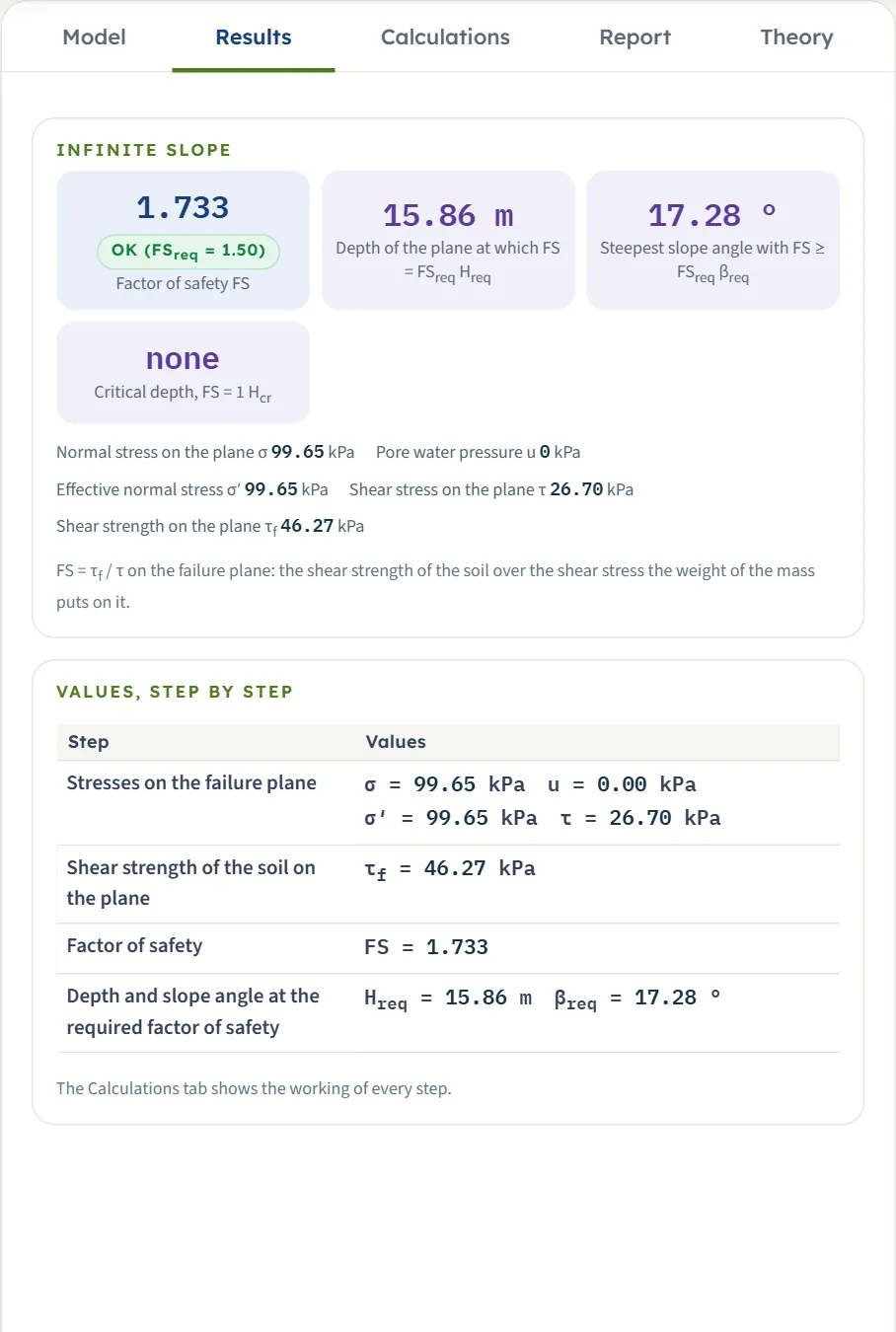
| Card | The example |
|---|---|
| Factor of safety FS | 1.733 OK (FSreq = 1.50) |
| Depth of the plane at which FS = FSreq Hreq | 15.86 m |
| Steepest slope angle with FS ≥ FSreq βreq | 17.28 ° |
| Critical depth, FS = 1 Hcr | none |
The verdict words
The factor of safety reads OK at or above FSreq, OK, near the limit within 10 % above it (1.583 at H = 10 m) and NOT OK below it. With an earthquake a second card carries the same words against FSreq,eq .
With water, with an earthquake
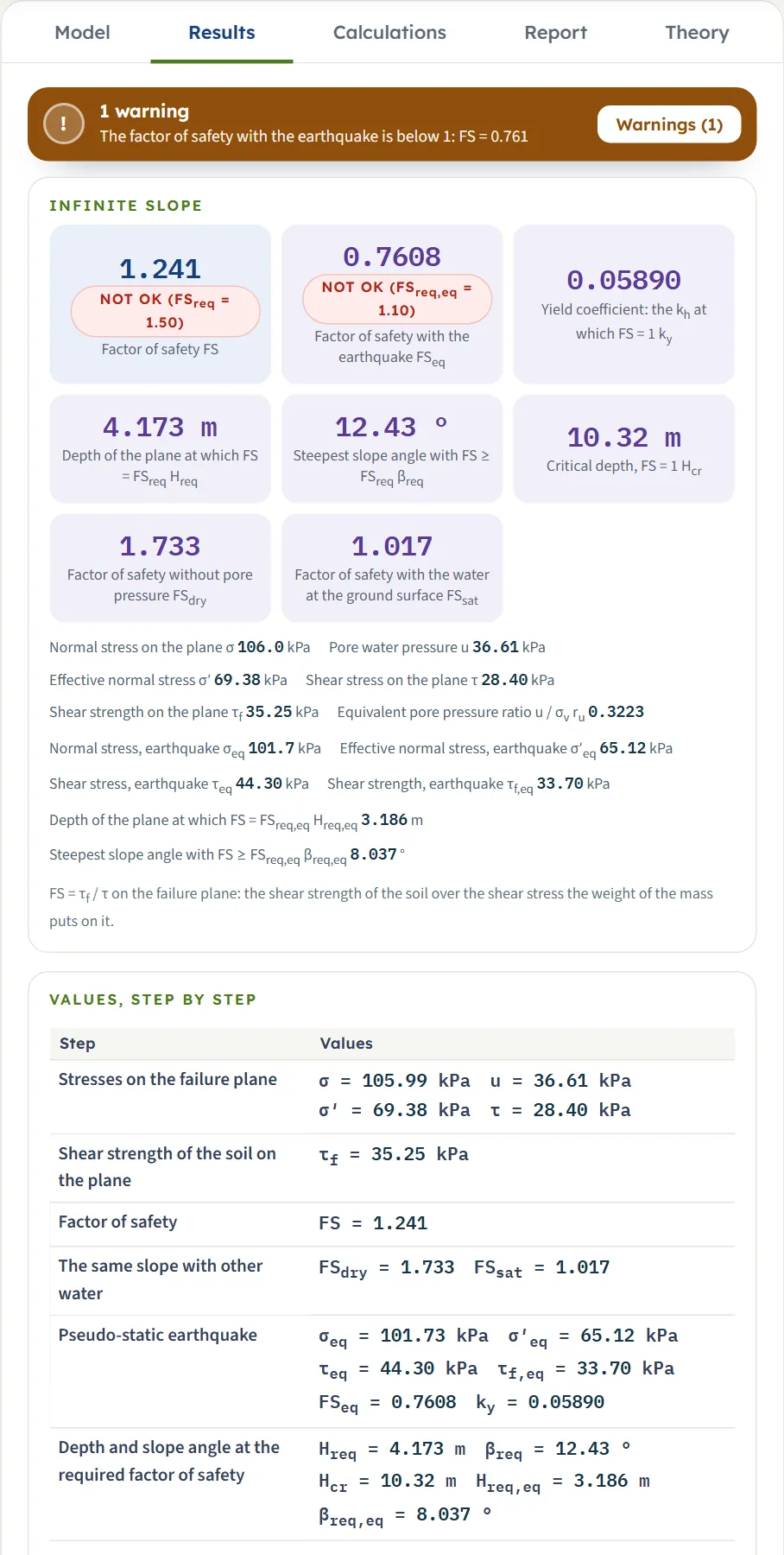
- With water two cards are added: the factor of safety without pore pressure FSdry and, with a water table, with the water at the ground surface FSsat, and the list gains the equivalent ratio u / σv.
- With an earthquake the cards add FSeq and the yield coefficient ky, and the list adds σeq, σ′eq, τeq, τf,eq , Hreq,eq and βreq,eq .
When a card has no number
- Hreq reads no limit when FS stays at or above the required value at every depth (the slope at 10°), and none when it is below it already at the shallowest depth (a dry soil with c′ = 0).
- βreq reads above 70° or none in the same way.
- Hcr reads none when FS stays at or above 1 at every depth, and every depth when it is below 1 everywhere.
- ky reads above 3 when FS stays above 1 up to kh = 3.
Using the numbers
- Hreq and βreq are found with the other inputs as entered; they are the depth and the angle to design to for the required value.
- ky is the horizontal coefficient the plane can take before FS reaches 1, with kv as given.
- Changing the unit system after Analyze re-states the cards, tables, working and report without a new run.
The Calculations tab, the report and the Theory tab
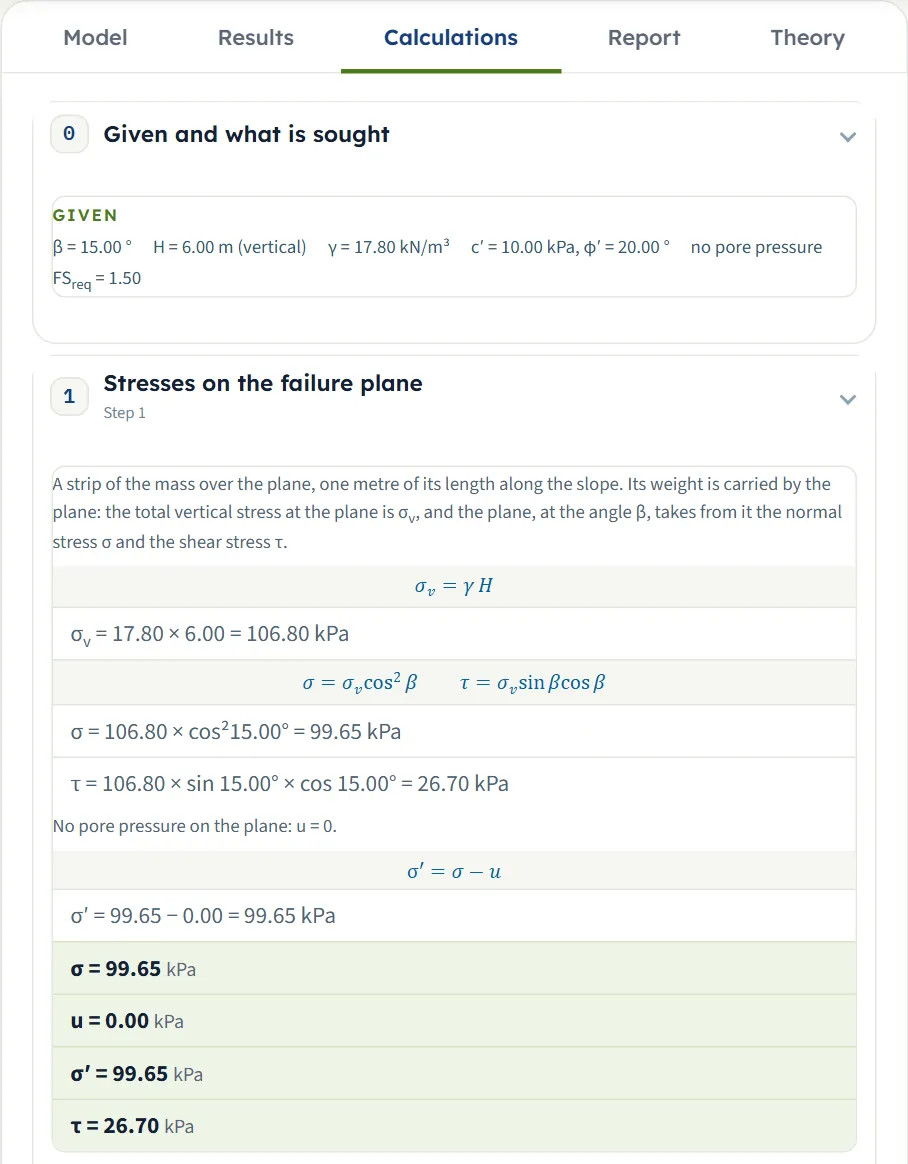
The Calculations tab opens with Given and what is sought and writes out the working in numbered steps, each with its equation, the equation with your numbers and the result:
- Stresses on the failure plane — σv, σ, τ, u and σ′.
- Shear strength of the soil on the plane — τf.
- Factor of safety — FS = τf / τ, and for a dry slope the same written in closed form.
- The same slope with other water (with water) — FSdry and FSsat.
- Pseudo-static earthquake (with an earthquake) — the forces, σ and τ of the earthquake case, FSeq and ky.
- Depth and slope angle at the required factor of safety — Hreq, βreq, Hcr (and the earthquake values).
The tab ends with Notes and assumptions. Before Analyze it says “Press Analyze on the Model tab to calculate the factor of safety.”
Notes and warnings
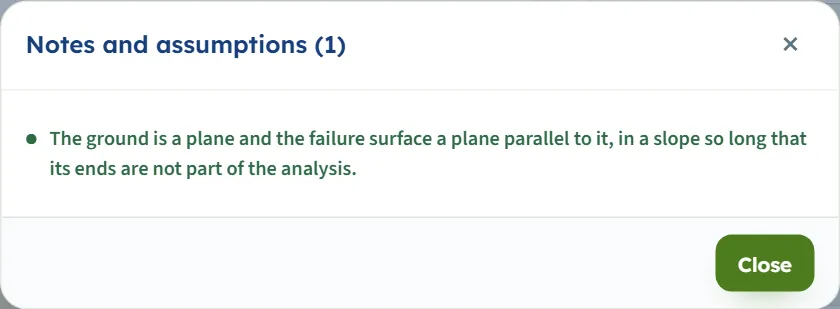
Notes (n) opens the assumptions of the run: the slope is a plane so long that its ends are not part of the analysis, and, as the case may be, that the water flows parallel to the ground, that ru gives the pore pressure, that the analysis is undrained in total stress, or that the shaking adds no pore pressure. A Warnings window opens by itself after Analyze when the run has a warning, with the warnings first; the Results tab then carries a brown banner “1 warning”.
The report
In Report fill in the cover (project, location, client, report number, date, prepared by, title / qualification, checked by, notes). The details are kept in this browser and saved with the model file. After Analyze, Save as PDF and Download Word (.docx) produce the report.
Its parts: 1 Introduction and scope, 2 Input data (with the section, stresses and charts drawings), 3 Calculation (3.1 to 3.4, one per step), 4 Results, 5 Assumptions and notes, 6 Summary and 7 References.

The Theory tab has eleven sections: Infinite slope, and this module; The idea: one strip of the mass; Strength, and the factor of safety; Undrained clay; Water in the slope; The earthquake, pseudo-static; The charts; Depth and angle at the required factor of safety; A worked example; What the module assumes, and what it does not do; and References.
Worked example: the module’s own example
The module opens on this example: β = 15°, H = 6 m, γ = 17.8 kN/m³, c′ = 10 kPa, φ′ = 20°, dry, FSreq = 1.50.
Step 1: the stresses
Step 2: the strength
Step 3: the factor of safety
FS = 46.27 / 26.70 = 1.733, above 1.50: OK. In closed form 10 / (17.8 × 6 × cos²15° × tan 15°) + tan 20° / tan 15° = 0.375 + 1.358 = 1.733.
Step 4: depth and angle
Hreq = 10 / (17.8 × cos²15° × tan 15° × (1.50 − 1.358)) = 15.86 m; the steepest angle with FS ≥ 1.50 is 17.28°; FS never falls to 1 at any depth, so there is no critical depth.
The same slope with a water table
Choose Water table, seepage parallel to the slope with zw = 2 m (γsat = 19.5): hw = 4 m, σv = 17.8 × 2 + 19.5 × 4 = 113.6 kPa, σ = 105.99 kPa, u = 9.81 × 4 × cos²15° = 36.61 kPa, σ′ = 69.38 kPa, τ = 28.40 kPa, τf = 10 + 69.38 × tan 20° = 35.25 kPa and FS = 1.241, NOT OK. The same slope with no pore pressure gives 1.733 and with the water at the surface 1.017; Hreq falls to 4.173 m.
The same slope with an earthquake
With Pseudo-static, kh = 0.15 and kv = 0: σ = 103.16 × (cos 15° − 0.15 sin 15°) = 95.64 kPa, τ = 103.16 × (sin 15° + 0.15 cos 15°) = 41.65 kPa, τf = 10 + 95.64 × tan 20° = 44.81 kPa and FSeq = 1.076, against 1.10: NOT OK. The yield coefficient is 0.1789.
In the other unit systems
In SI · tf the example gives σ = 10.16 t/m², τ = 2.723 t/m² and τf = 4.718 t/m² (99.65 / 9.80665, 26.70 / 9.80665, 46.27 / 9.80665). In US the boxes show H = 19.685 ft, γ = 113.313 pcf and c′ = 208.854 psf, and the results σ = 2.081 ksf, τ = 0.5576 ksf, τf = 0.9663 ksf and Hreq = 52.05 ft; the factor of safety is 1.733 in all three.
How each input changes the answer
Each row changes one thing in the example (β = 15°, H = 6 m, γ = 17.8 kN/m³, c′ = 10 kPa, φ′ = 20°, dry, FSreq = 1.50) and runs the module again. Rows with water use γsat = 19.5 kN/m³ and γ = 17.8 kN/m³. The undrained rows have γ = 17.8 kN/m³ and no c′, φ′. The numbers are the ones the module gives.
| Change | FS | Hreq βreq |
|---|---|---|
| The example | 1.733 | 15.86 m 17.28° |
| β = 10° | 2.612 | no limit 17.28° |
| β = 20° | 1.291 | 3.496 m 17.28° |
| β = 25° | 1.025 | 2.039 m 17.28° |
| H = 3 m | 2.107 | 15.86 m 21.11° |
| H = 10 m | 1.583 | 15.86 m 15.81° |
| c′ = 0 | 1.358 | none 13.64° |
| c′ = 20 kPa | 2.107 | 31.73 m 21.11° |
| φ′ = 15° | 1.375 | 4.494 m 13.76° |
| φ′ = 30° | 2.529 | no limit 24.73° |
| γ = 20 kN/m³ | 1.692 | 14.12 m 16.87° |
| Water table zw = 4 m | 1.479 | 5.860 m 14.80° |
| Water table zw = 2 m | 1.241 | 4.173 m 12.43° |
| Water table zw = 0 | 1.017 | 2.486 m 10.17° |
| ru = 0.1 | 1.587 | 7.824 m 15.85° |
| ru = 0.25 | 1.369 | 4.444 m 13.74° |
| ru = 0.5 | 1.005 | 2.584 m 10.30° |
| ru = 0.9 | 0.4226 | 1.548 m 4.889° |
| Undrained, cu = 40 kPa | 1.498 | 5.993 m 14.98° |
| Undrained, cu = 80 kPa | 2.996 | 11.99 m 43.57° |
| FSreq = 1.3 | 1.733 | no limit 19.87° |
| FSreq = 2 | 1.733 | 3.502 m 13.02° |
- The slope angle: from 10° to 25° the factor of safety falls from 2.612 to 1.025, and the critical depth appears (6.683 m at 25°).
- The depth matters when there is cohesion: c′ shares the load over a thicker mass, so FS falls from 2.107 at 3 m to 1.583 at 10 m. A dry cohesionless soil gives the same FS at every depth.
- Cohesion acts through c′ / (γ H cos²β tan β): 0.375 in the example, so c′ = 0 lowers FS from 1.733 to 1.358.
- The water reduces σ′: a table 4 m below the ground costs 0.25, at the surface 0.72. A table at or below the plane (6 m) changes nothing.
- ru = 0.9 takes FS to 0.4226 and opens a warning.
- FSreq does not change FS, only the verdict and the depth and angle: 1.3 gives OK with no limit on the depth; 2 gives NOT OK and 3.502 m.
The earthquake
| kh, kv | FSeq | ky |
|---|---|---|
| 0.05, 0 | 1.445 | 0.1789 |
| 0.15, 0 | 1.076 | 0.1789 |
| 0.30, 0 | 0.7660 | 0.1789 |
| 0.15, 0.1 | 1.057 | 0.1702 |
| 0.15, 0.3 | 1.009 | 0.1527 |
The yield coefficient does not depend on the kh you enter: it is the kh at which FS falls to 1, with kv as given. With kh = 0 and kv = 0 the earthquake case equals the static one (1.733) and the module notes it.
Messages: when the module stops or warns
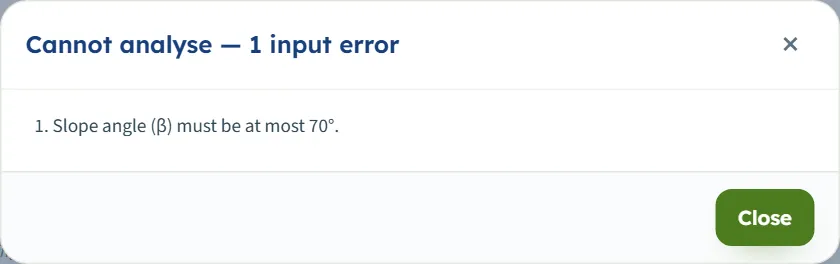
A value outside its range is checked when you press Analyze: a window Cannot analyse — 1 input error names the field and the limit, and nothing is calculated. The Results tab then says “Press Analyze on the Model tab to calculate the factor of safety.” and the bar stays Not analysed.
| Message | When |
|---|---|
| “Slope angle (β) must be at least 0.1°.” / “… at most 70°.” | β outside 0.1° to 70° |
| “Depth of the failure plane (H) must be at least 0.05 m.” | H below 0.05 m |
| “Unit weight of the soil (γ) must be at least 1 kN/m³.” | γ below 1 |
| “Effective friction angle (φ′) must be at most 50°.” | φ′ above 50° |
| “Effective cohesion (c′) must be at least 0 kPa.” | c′ negative |
| “Undrained shear strength (cu) must be at least 0.1 kPa.” | cu below 0.1 |
| “Depth of the water table below the ground (zw) must be at least 0 m.” | zw negative |
| “Pore pressure ratio (ru) must be at most 0.9.” | ru above 0.9 |
| “Horizontal seismic coefficient (kh) must be at most 1.” / “Vertical seismic coefficient (kv) must be at most 0.5.” | kh above 1, kv above 0.5 |
| “Required factor of safety (FSreq) must be at least 1.” / “… earthquake (FSreq,eq) must be at least 1.” | a required value below 1 |
| “Slope angle (β) is missing.” / “Depth of the failure plane (H) is missing.” | an empty box |
One more stop, a window Cannot analyse — a condition of the solution is not met, comes from the saturated unit weight: “The saturated unit weight 9.00 kN/m³ is not above that of water. Below the water table the effective unit weight (saturated minus that of water) would be zero or negative. Enter the saturated unit weight of the soil.” It ends with “Nothing was calculated. Change the inputs marked in red, then press Analyze again.”
Warnings
Warnings are given after a run that is calculated; the window opens by itself. Two of them:
- “The factor of safety is below 1: FS = 0.423.” with the text “The shear stress on the plane is larger than the strength of the soil there: the mass is not in equilibrium on this plane. Flatten the slope, lower the pore pressure, or check the strength and the unit weights entered.” (here ru = 0.9)
- “The factor of safety with the earthquake is below 1: FS = 0.766.” with the text “… in a pseudo-static analysis the mass would move on this plane during the shaking. Flatten the slope, lower the pore pressure, or check the coefficients and the strength entered.” (here kh = 0.3)
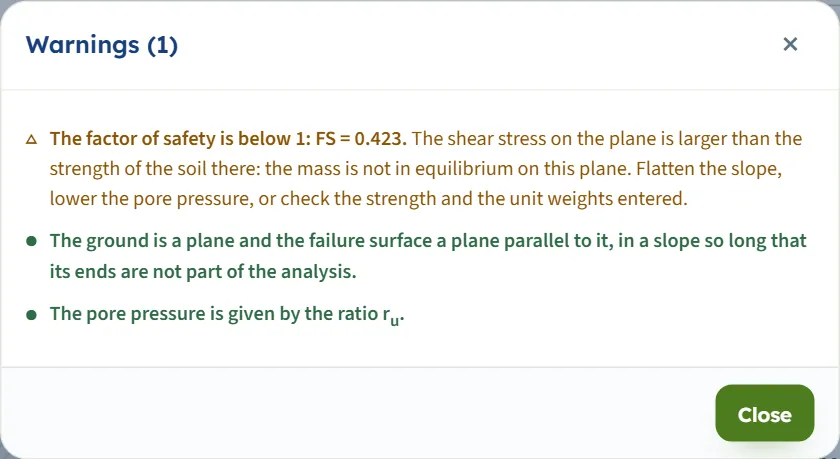
A third warning, that the effective normal stress on the plane is not positive, is written when the pore pressure carries more than the normal force, so that friction cannot act and the strength is the cohesion alone; check ru or the table and the unit weights then.
A result below the required value is not a stop: the card reads NOT OK and the numbers are given.
Good practice and common mistakes
- Check that the model fits. The module treats a long slope with a plane parallel to the ground; for a slope of limited length or a deep circular surface use Slope stability.
- Measure H vertically, as a borehole meets the plane, not at right angles to the slope.
- Enter γ as the unit weight above the water table and γsat below it; the module stops if γsat is not above 9.81 kN/m³.
- Run the water two ways when you are unsure: with the table at the surface and with the ratio. They agree when ru = γw cos²β / γ and γ = γsat.
- Read FSdry and FSsat to see how much the water costs.
- Choose the coefficients knowingly. kh and kv are the ones you enter; the vertical force is applied in the less favourable direction.
- Use ky to judge the margin of the earthquake case: the horizontal coefficient the plane can take before FS reaches 1.
- Set FSreq for your project before reading the verdict and the depth and angle.
- Note your model. It is kept in this browser; Save to file… keeps it with the project and the report is the record.
Frequently asked questions
How is the factor of safety of an infinite slope calculated?
It is the shear strength of the soil on the plane over the shear stress the weight puts on it: FS = τf / τ with σ = σv cos²β and τ = σv sin β cos β. For the example σ = 99.65 kPa, τ = 26.70 kPa, τf = 46.27 kPa and FS = 1.733.
Why does the depth matter for a cohesive soil but not for a sand?
The friction term, tan φ′ / tan β, does not depend on H; the cohesion term c′ / (γ H cos²β tan β) falls as H grows. A dry cohesionless slope has FS = tan φ′ / tan β at every depth (1.340 for 32° and 25°).
What do the depth and angle cards mean?
Hreq is the depth at which FS falls to the required value, βreq the steepest slope angle that keeps it at the depth you gave, and Hcr the depth where FS falls to 1. They are found with the other inputs as entered.
How is the water taken?
A water table parallel to the slope gives u = γw hw cos²β with hw = H − zw, and γsat below the table; zw = 0 is the water at the ground surface. A ratio gives u = ru γ H.
What is the yield coefficient?
The horizontal coefficient kh at which the earthquake factor of safety falls to 1, with kv as given. For the example it is 0.1789; for a dry cohesionless soil it is tan (φ′ − β).
Which direction does the vertical force take?
The one that gives the lower factor of safety, upward or downward; the Calculations tab shows both factors and the one kept. In an undrained analysis the larger shear stress governs.
Can I use an undrained strength with water?
No. An undrained analysis is in total stress, so the Pore water choices are not offered; the factor of safety is cu / (γ H sin β cos β).
What values does the module accept?
β from 0.1° to 70°, H from 0.05 m, γ from 1 kN/m³, φ′ from 0° to 50°, ru from 0 to 0.9, kh from 0 to 1, kv from 0 to 0.5 and the required values from 1 to 5. Others stop the analysis with a message that names the field.
Can I drag the slope or the plane?
No. Set β, H and zw in the Model tab; the drawing follows. The zoom buttons enlarge each view.
Does the module remember my inputs?
Yes. Every change is kept in this browser, with the analysed state, and the page opens on the model you last worked on. Reset to defaults restores the example; Save to file… keeps the model outside the browser.
Which units does it use?
SI · kN, SI · tf or US, switchable at any time. The stresses are in kPa, t/m² or ksf, the depths in m or ft and the unit weights in kN/m³, tf/m³ or pcf; the factor of safety and the coefficients have no unit.
What does the report contain?
A cover with your project details, then Introduction and scope, Input data with the drawings, the Calculation step by step, Results, Assumptions and notes, Summary and References, as a PDF or a Word file after Analyze.