
On this page · 5 chapters
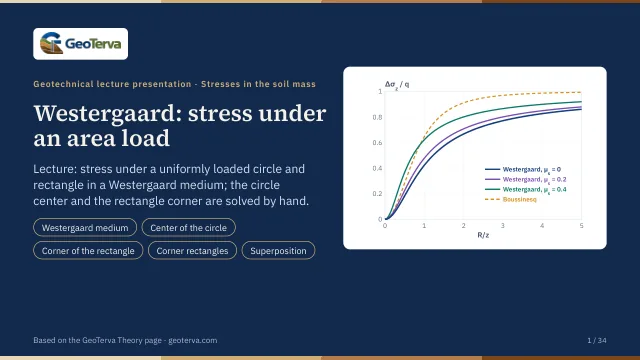
The vertical stress below a uniformly loaded circle and rectangle on a Westergaard material, compared with Boussinesq's. The figures are computed from the equations.
 PDF
Lecture slides
Ready-made slides for lectures and self-study
The mechanism, the derivation, the equations and the figures of this page, in teaching order. Every slide links back to its chapter.
1ScopeLoaded areas on a Westergaard material.
Westergaard's point-load solution can be integrated over a loaded area just as Boussinesq's was for the circle and the rectangle. Two closed results follow for a flexible, uniformly loaded area on a Westergaard material: the stress below the centre of a circle and below the corner of a rectangle.
Throughout,
μs being Poisson's ratio of the soil between the rigid layers; for μs = 0, η = 1/√2.
2Circular areaBelow the centre.
Below the centre of a uniformly loaded flexible circle of radius R:
It follows from the point load: an element r dr dα carries q r dr dα, and with the influence value I5 of the point load the r-integral is elementary, [(r/ηz)² + 1]−1/2 between 0 and R.
| R/z | Δσz/q | R/z | Δσz/q |
|---|---|---|---|
| 0.25 | 0.0572 | 0.33 | 0.0938 |
| 0.5 | 0.1835 | 0.75 | 0.3140 |
| 1 | 0.4226 | 1.25 | 0.5076 |
| 1.5 | 0.5736 | 2 | 0.6667 |
| 2.5 | 0.7278 | 3 | 0.7706 |
| 4 | 0.8259 | 5 | 0.8600 |
| 10 | 0.9295 |
3Rectangular areaBelow a corner: Iw.
Below a corner of a uniformly loaded flexible rectangle B × L, with m = B/z and n = L/z:
| m | n = 0.1 | n = 0.4 | n = 1 | n = 2 | n = 5 | n = 10 |
|---|---|---|---|---|---|---|
| 0.1 | 0.0031 | 0.0110 | 0.0182 | 0.0211 | 0.0221 | 0.0223 |
| 0.2 | 0.0061 | 0.0214 | 0.0357 | 0.0413 | 0.0434 | 0.0438 |
| 0.5 | 0.0129 | 0.0459 | 0.0781 | 0.0916 | 0.0969 | 0.0977 |
| 1 | 0.0182 | 0.0658 | 0.1161 | 0.1398 | 0.1498 | 0.1515 |
| 2 | 0.0211 | 0.0768 | 0.1398 | 0.1743 | 0.1916 | 0.1948 |
| 10 | 0.0223 | 0.0817 | 0.1515 | 0.1948 | 0.2250 | 0.2341 |
Any other point follows from four corner rectangles with signs, exactly as for the Boussinesq rectangle; the module does this.
4Worked exampleEvery number computed by the module’s own code.
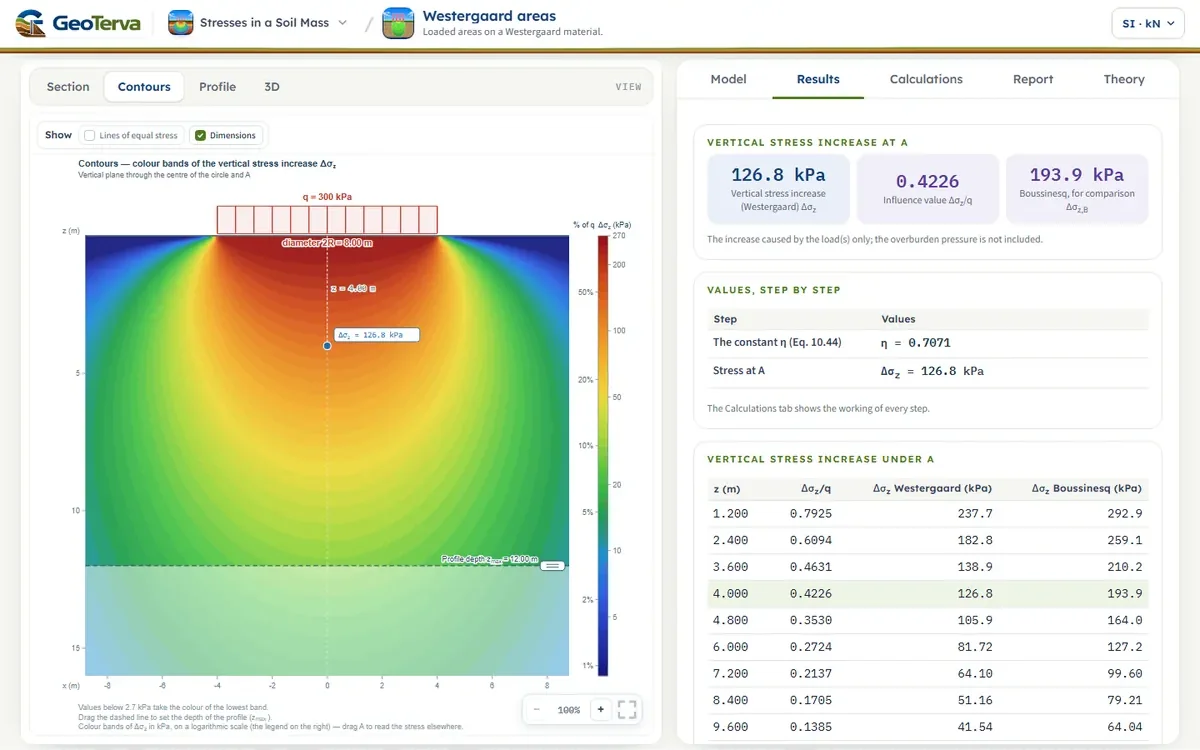
A flexible circle, R = 4 m, q = 300 kN/m². Compare Δσz below the centre by Boussinesq and by Westergaard (μs = 0) for z = 0 to 12 m.
| z (m) | z/R | Boussinesq | Westergaard |
|---|---|---|---|
| 0.4 | 0.1 | 299.70 | 278.84 |
| 2 | 0.5 | 273.17 | 200.00 |
| 4 | 1.0 | 193.93 | 126.79 |
| 6 | 1.5 | 127.19 | 81.72 |
| 8 | 2.0 | 85.34 | 55.05 |
| 10 | 2.5 | 59.88 | 38.88 |
| 12 | 3.0 | 43.86 | 28.64 |
Below the centre the Westergaard stress is the smaller at every depth: the rigid layers spread the load sideways. The module opens with this example at z = 4 m (126.8 against 193.9 kN/m²); choose Rectangle for the rectangular area. Further areas — circles and rectangles, each with its own q, size and centre on the ground — are put in one by one with Add loaded area (up to eight); two areas may touch but not overlap and, the Westergaard medium being elastic, the stress of each is found with its own distance from A and the stresses add.
5ReferencesSources.
- Das, B.M. (2018). Principles of Geotechnical Engineering, 9th ed. Cengage Learning.
- Westergaard, H.M. (1938). A problem of elasticity suggested by a problem in soil mechanics: soft material reinforced by numerous strong horizontal sheets. In Contributions to the Mechanics of Solids, Stephen Timoshenko 60th Anniversary Volume. Macmillan, New York, 268–277.
From theory to your own design
Find the Westergaard stress for your own areas in minutes
- The vertical stress increase at a point below circles and rectangles together
- The comparison with Boussinesq
- The depth profile
- A clean calculation report, saved as a PDF. Online: nothing to install, no dongle, on a phone, a tablet or a PC