
On this page · 6 chapters
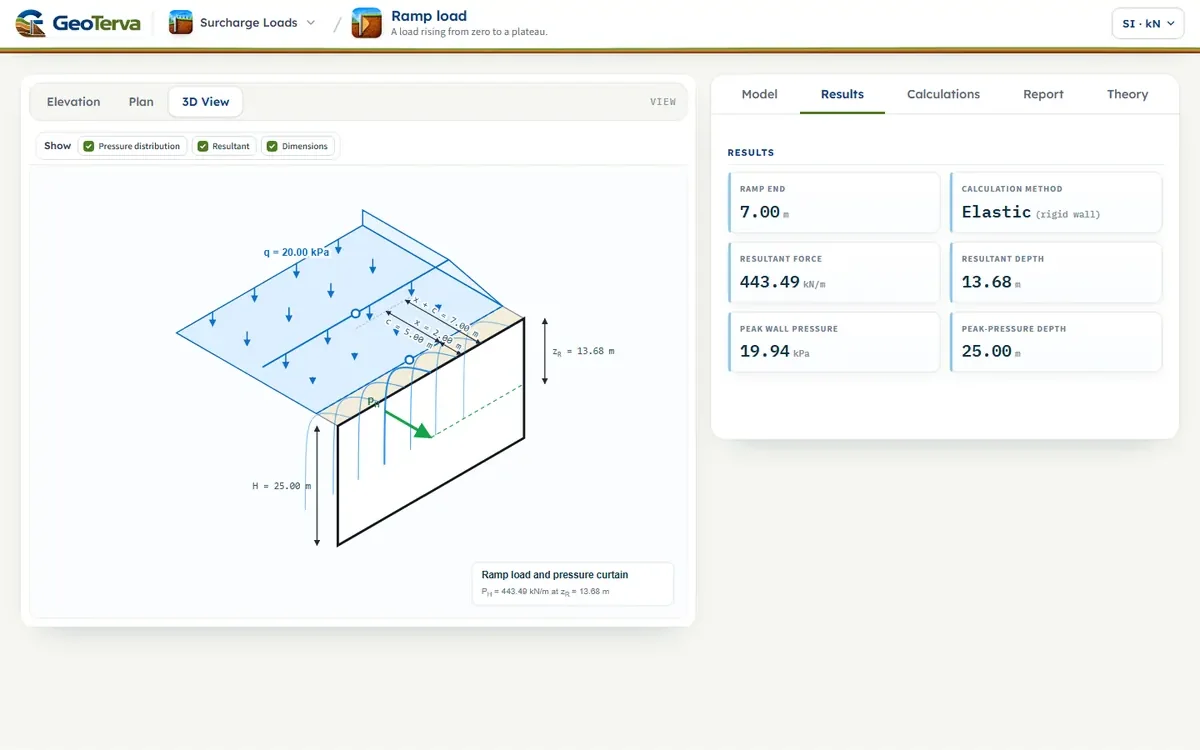
The horizontal pressure that a ramp surcharge, parallel to a vertical wall, adds to the wall: the radii and angles at a depth, the pressure as the superposition of line loads, the resultant and its line of action. The figure and every number are computed from the module's own equations.
 PDF
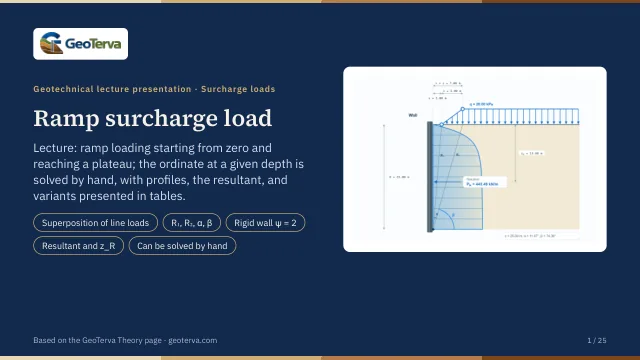
Lecture slides
Ready-made slides for lectures and self-study
The mechanism, the derivation, the equations and the figures of this page, in teaching order. Every slide links back to its chapter.
1Ramp load on a wallWhat the module computes.
The ramp surcharge begins at a horizontal distance x from the wall. The surface pressure increases linearly from zero to the full value q over the ramp width c. Beyond x + c the surcharge continues at the constant intensity q.
Variables
- — total wall height
- — distance from the wall to the start of the ramp
- — horizontal width over which the load rises from 0 to q
- — full uniform surcharge intensity beyond the ramp
- — depth below the ground surface at which σH is evaluated
2Radii and anglesThe geometry at a depth z.
At the depth z the two rays from the wall point to the start and to the end of the ramp have the lengths
and the two angles are
Use radians in the pressure equation. Degrees can be shown in the interface and in the calculation report for readability.
3Horizontal pressureThe superposition of line loads.
A ramp load is a continuous row of line loads of intensity w(s)·ds — rising over the ramp, constant on the plateau. Adding their elastic horizontal stresses (Flamant) gives the pressure exactly:
The rising ramp and the plateau each produce extra algebraic terms, and those cancel exactly, leaving the angles and the logarithm:
ψ = 1 is the half-space (no wall); ψ = 2 is a rigid wall that does not yield, which doubles the horizontal stress — the module's default, as for the other surcharge loads. Evaluating the expression over the complete wall height gives σH(z); it is zero at the ground surface.
| z (m) | R1 (m) | R2 (m) | α (°) | β (°) | σH half-space (kPa) | σH rigid wall (kPa) |
|---|---|---|---|---|---|---|
| 1.00 | 2.24 | 7.07 | 18.435 | 8.130 | 3.02 | 6.03 |
| 2.50 | 3.20 | 7.43 | 31.686 | 19.654 | 6.14 | 12.28 |
| 5.00 | 5.39 | 8.60 | 32.661 | 35.538 | 8.46 | 16.92 |
| 7.50 | 7.76 | 10.26 | 28.094 | 46.975 | 9.30 | 18.60 |
| 10.00 | 10.20 | 12.21 | 23.682 | 55.008 | 9.64 | 19.27 |
| 15.00 | 15.13 | 16.55 | 17.422 | 64.983 | 9.87 | 19.74 |
| 20.00 | 20.10 | 21.19 | 13.579 | 70.710 | 9.94 | 19.88 |
| 25.00 | 25.08 | 25.96 | 11.068 | 74.358 | 9.97 | 19.94 |
4Resultant and line of actionArea of the diagram and its first moment.
The resultant surcharge force per unit length of wall and its depth below the ground are the area of the diagram and its first moment:
The module integrates both numerically to full precision. For the example, PH = 443.49 kN/m (rigid wall) or 221.74 kN/m (half-space), at zR = 13.68 m below ground level in both.
5Worked exampleThe sequence by hand and one ordinate.
The data are H = 25.00 m, x = 2.00 m, c = 5.00 m and q = 20.00 kPa; the example is fixed and does not follow the inputs of the interface. By hand, the sequence is:
- Define H, x, c and q — they define the ramp and the constant surcharge beyond it — and choose ψ.
- Select a depth z between ground level and the wall base.
- Calculate R₁ and R₂ (Eq. (1), Eq. (2)) from the start point x and the end of the ramp x + c.
- Calculate α and β (Eq. (3), Eq. (4)), the angular geometry of the two rays.
- Calculate σH from Eq. (6), substituting q, c, x, α, β, R₁ and R₂.
- Repeat and integrate to build the pressure profile, then PH and zR.
The ordinate at z = 5.00 m
With the angles in radians:
6ReferencesSources.
- Das, B.M. (2016). Principles of Foundation Engineering, 8th ed. Cengage Learning; this page follows it.
From theory to your own design
Find the pressure from your own ramp load in minutes
- The pressure with depth, and the resultant with its height
- A load rising from zero to a plateau that runs on without end
- Elevation, plan and 3D views
- A clean calculation report, saved as a PDF. Online: nothing to install, no dongle, on a phone, a tablet or a PC