
On this page · 4 chapters
The vertical stress below a horizontal line load, and below an inclined one by its vertical and horizontal components. The figures are computed from the equations.
 PDF
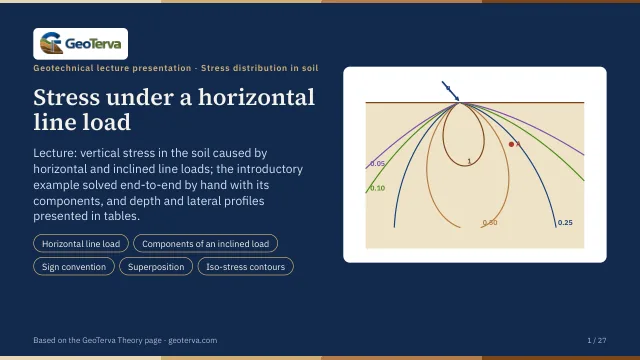
Lecture slides
Ready-made slides for lectures and self-study
The mechanism, the derivation, the equations and the figures of this page, in teaching order. Every slide links back to its chapter.
1Scope and assumptionsHorizontal and inclined line loads.
A line load may push along the surface rather than down on it — the friction of a long wall base, the braking of a rail track, the thrust of an arch. This module gives the vertical stress increase under a horizontal line load and, by adding the two components, under an inclined one.
- A flexible line load of infinite length along y; q per unit length; plane strain in every cross section.
- The soil is a homogeneous, isotropic, linearly elastic half-space.
- Δσz is an increase caused by the load only.
2The vertical stressΔσz = (2q/π) x z²/(x² + z²)².
The elastic solution for a horizontal line load gives the vertical stress increase at A as
Its sign follows x: the vertical stress increases on the side the load pushes toward (x > 0) and decreases on the other side; right under the load (x = 0) it is zero. In nondimensional form
| x/z | Δσz/(q/z) | x/z | Δσz/(q/z) |
|---|---|---|---|
| 0.00 | 0.000 | 0.10 | 0.062 |
| 0.20 | 0.118 | 0.30 | 0.161 |
| 0.40 | 0.189 | 0.50 | 0.204 |
| 0.60 | 0.207 | 0.70 | 0.201 |
| 0.80 | 0.189 | 0.90 | 0.175 |
| 1.00 | 0.159 | 1.25 | 0.121 |
| 1.50 | 0.090 | 2.00 | 0.051 |
3An inclined line loadComponents and superposition, worked through.
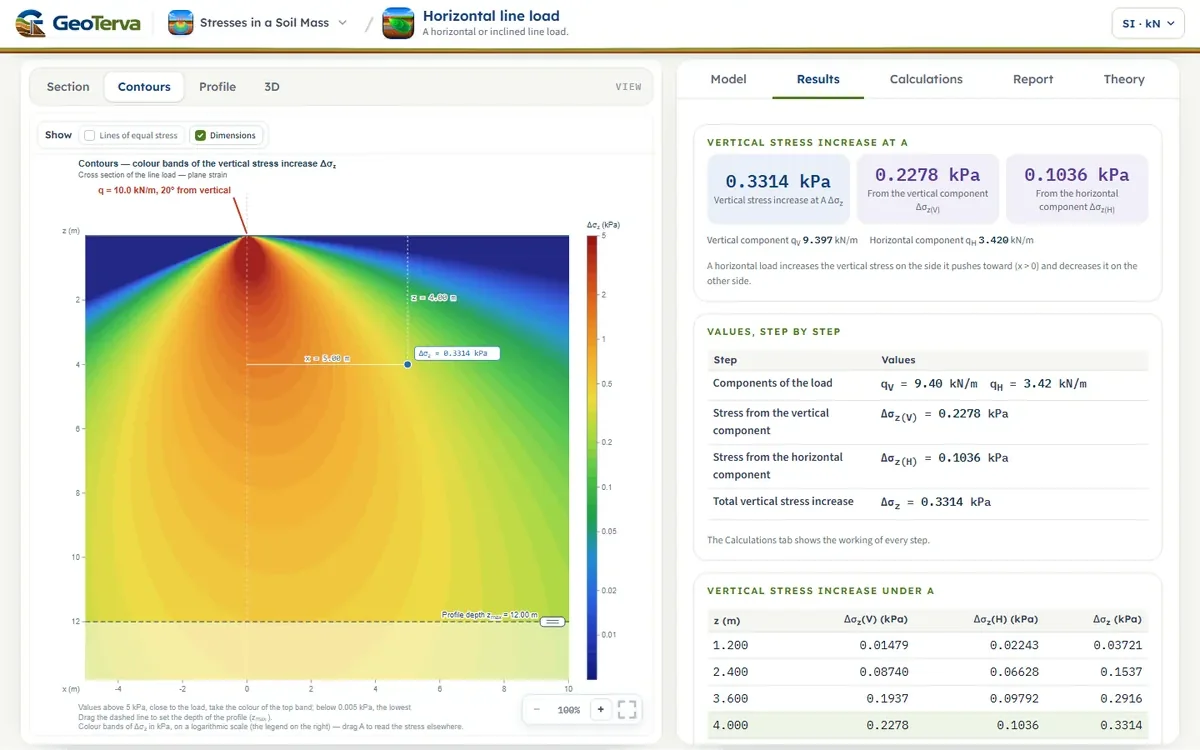
An inclined line load q at the angle α from the vertical is the sum of its components, and the soil being elastic, their stresses add:
For the example of the figure: qV = 10 cos 20° = 9.40 kN/m and qH = 10 sin 20° = 3.42 kN/m; x/z = 5/4 = 1.25:
The module opens with this example; α = 90° gives the purely horizontal load, α = 0 the vertical one. Further line loads, each with its own magnitude, inclination and position, are put in one by one with Add line load (up to eight, no two at the same position); the soil is elastic, so the stresses of the loads add.
4ReferencesSources.
- Das, B.M. (2018). Principles of Geotechnical Engineering, 9th ed. Cengage Learning.
From theory to your own design
Find the stress below your own inclined line loads in minutes
- The vertical stress increase at a point and its two parts
- Horizontal or inclined line loads, one or several
- The depth profile and the contours
- A clean calculation report, saved as a PDF. Online: nothing to install, no dongle, on a phone, a tablet or a PC