
On this page · 7 chapters
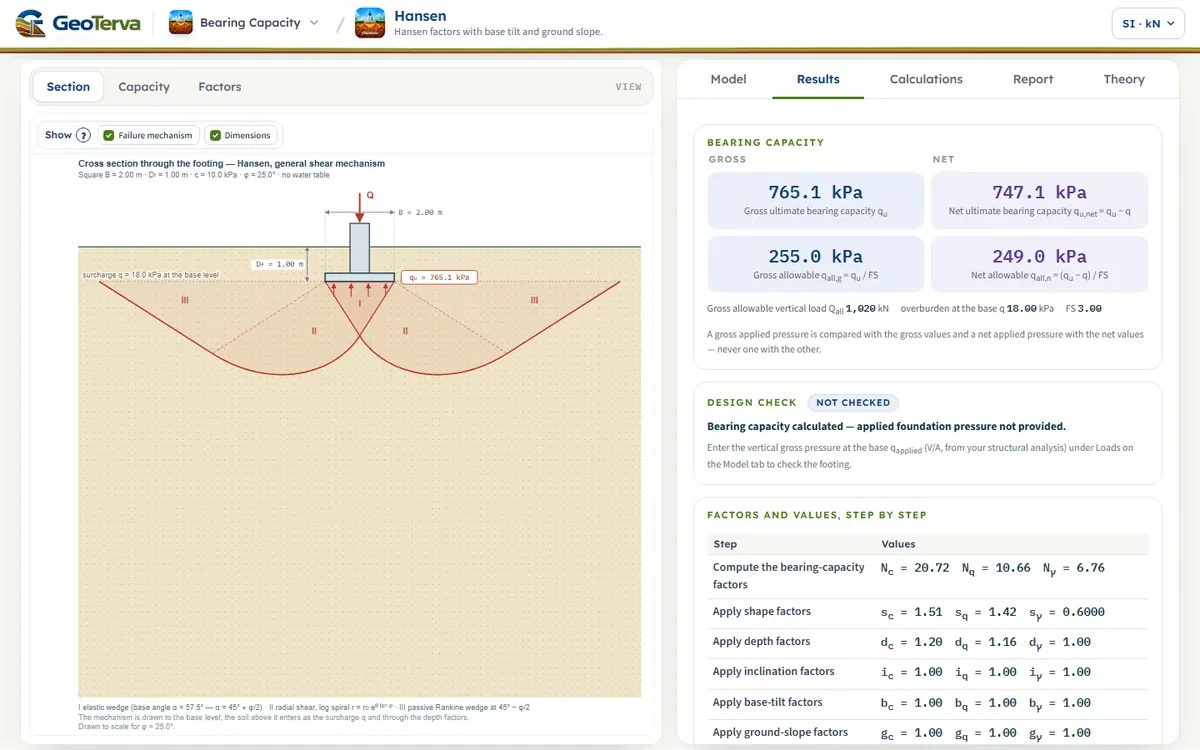
The Meyerhof tool in this section already extends Terzaghi's equation to any footing shape, any depth, and an inclined load. This page covers the one thing that combination still cannot do: account for a footing whose own base is not level, or ground next to the footing that slopes away rather than sitting flat. Hansen's (1970) equation is the standard answer to both — one complete equation, built the same way as the others, with two additional families of correction factors layered on.
 PDF
Lecture slides
Ready-made slides for lectures and self-study
The mechanism, the derivation, the equations and the figures of this page, in teaching order. Every slide links back to its chapter.
1A genuinely different equation, not just more factors
It would be easy to assume every "general" bearing-capacity equation is really the same equation with different names attached to the same numbers. It is not. Hansen (1970) worked out his own bearing-capacity factors independently of Vesic, using a slightly different idealisation of the failure surface beneath the footing — and while Nc and Nq come out identical to Reissner's and Prandtl's closed forms (as they do for every method in this section), Nγ does not.
| φ (deg) | Nγ — Hansen (this tool) | Nγ — Vesic (Meyerhof tool) |
|---|---|---|
| 10 | 0.39 | 1.22 |
| 15 | 1.18 | 2.65 |
| 20 | 2.95 | 5.39 |
| 25 | 6.76 | 10.88 |
| 30 | 15.07 | 22.40 |
| 32 | 20.79 | 30.21 |
| 35 | 33.92 | 48.03 |
| 40 | 79.54 | 109.41 |
| 45 | 200.81 | 271.75 |
Neither value is "more correct" than the other in any absolute sense — both come from reputable, widely used derivations, and the gap between them is a genuine reminder that Nγ has no closed, universally agreed form the way Nc and Nq do. Hansen's equation, used consistently with its own Nγ and its own shape and inclination factors rather than mixed with another method's numbers, is what this tool computes throughout.
2Shape and depth factors
Hansen's shape factors play the same role as De Beer's in the Meyerhof tool — correcting for a footing that is not an infinitely long strip — and are close in form, though not identical:
For undrained loading (φ = 0), Hansen gives the cohesion shape factor a separate, simpler form rather than the Nq/Nc ratio above, which is not well behaved as φ → 0. It is primed, s′c, because it is not a multiplier: it is added to 1 in the φ = 0 form of the equation (see “The undrained case” below).
Depth factors are unchanged from the Meyerhof tool — literally the same functions, since Hansen (1970) is where they come from in the first place:
3Inclination, by the actual load, not just an angle
Meyerhof's inclination factors, used in the previous tool, only need the angle between the load and the vertical. Hansen's need more: the actual ratio between the applied horizontal and vertical bearing pressure, adjusted for how much the soil's own cohesion is already helping resist sliding.
Here h and v are the applied horizontal and vertical bearing pressure of ONE load case, H/A and V/A — the actual working load the footing is checked against, not the ultimate capacity being solved for. In this module v is qapplied, the vertical gross pressure at the base, so the inclination factors and the check of the footing use the same load; with h > 0 the module needs qapplied. On a tilted base Hansen reduces the 0.7 of iγ by η°/450° (Bowles 1996, Table 4-5b). As the ratio h/(v + c·cot φ) grows, the inclination factors collapse toward zero: a footing close to sliding has little bearing capacity left to offer, regardless of how strong the soil beneath it otherwise is. The formula for ic reaches zero before the ratio reaches 1 (once iq falls below 1/Nq), and this module holds it at zero from there on rather than let the cohesion term turn negative.
The ratio itself may not reach 1. The base slides once h exceeds its frictional and adhesive resistance, at most v·tan φ + c = tan φ·(v + c·cot φ) per unit area, which is already below v + c·cot φ; the module warns when h passes that bound, and refuses to give a bearing capacity at all once h ≥ v + c·cot φ.
At φ = 0 the factor takes a separate, additive form, and iq = iγ = 1. It is defined only while h < c — beyond that the horizontal load exceeds the undrained strength along the base, and the module stops:
4Base tilt and ground slope — Hansen's own contribution
Every other equation in this section implicitly assumes a level footing base sitting on level ground extending well past the edges of the footing. Real sites are not always so obliging: a footing might be intentionally battered, or sit at the top of an embankment where the ground falls away on one side. Hansen's equation is the one in this section built to handle both.
Both angles are measured in degrees for the c-term formulas and in radians inside the exponentials, and default to zero in this module — a level base on level ground — in which case every one of these six factors equals 1 and drops out of the equation entirely, leaving exactly the shape/depth/inclination equation described above. Note that the self-weight factor bγ carries a larger exponent (2.7) than bq (2): a tilted base costs the self-weight term more than the surcharge term.
The ground-slope factors gq = gγ = (1 − 0.5 tan ω)⁵ are Hansen's own (Hansen 1970; Bowles 1996, Table 4-5b). The literature keeps two forms apart: (1 − tan ω)², which some texts print next to Hansen's equation, is Vesic's — the Vesic tool uses it — and it is a little larger, so it would overstate Hansen's capacity (at ω = 5°: 0.8327 against 0.7996). Until 2026-09-19 this module used (1 − tan ω)² here. Both forms assume a slope no steeper than the soil's friction angle: the module stops when ω > φ, and it accepts η and ω only up to 45°.
5Putting it together
Six correction factors on each of the three terms looks intimidating written out in full, but every one of them equals 1 in the ordinary case this module opens with — a level footing, level ground, no horizontal load. The full machinery only engages once one of those simplifying assumptions stops holding, which is exactly when Terzaghi's and even Meyerhof's equations run out of things to say.
The water table and the factor-of-safety step work exactly as they do in the other two tools in this section — the same two groundwater cases, and the same ultimate-to-allowable division by a factor of safety of three or more.
6The undrained case (φ = 0)
At φ = 0 the multiplicative cohesion term above is not used. Hansen writes it in an additive form instead: the primed factors are added to 1 (or subtracted from it) rather than multiplied, so a strip footing with no horizontal load, no tilt and no slope keeps its full cohesion term cNc instead of losing it to a zero factor. With Nq = 1, Nγ = 0 and every other surcharge factor equal to 1 at φ = 0, the surcharge term reduces to q·gq — just q on level ground — and the self-weight term vanishes:
Here Nc = 5.14 and k = Df/B (or arctan(Df/B) past Df/B = 1), so d′c = dc − 1, b′c = 1 − bc and g′c = 1 − gc are the same corrections as above, written as increments. For a 2 m square footing at 1 m depth on clay with c = 40 kPa and γ = 18 kN/m³, with no horizontal load, tilt or slope: qu = 40 × 5.14 × (1 + 0.2 + 0.2) + 18 = 305.84 kPa.
7Reference
Hansen's complete bearing-capacity equation — his own Nγ, shape factors, inclination factors, and base-tilt and ground-slope factors — follows Hansen, J.B., A Revised and Extended Formula for Bearing Capacity, Danish Geotechnical Institute Bulletin 28, 1970, as restated consistently across standard geotechnical references. The depth factors used across this whole section are Hansen's, as set out in Das, B.M., Principles of Geotechnical Engineering, 9th ed., Cengage Learning, 2018 (Chapter 16).
From theory to your own design
Find the Hansen capacity of your own footing in minutes
- The ultimate and the allowable capacity, with every factor written out
- A footing near a slope, on a tilted base or under an inclined load
- The section drawn with the slope and the tilt
- A clean calculation report, saved as a PDF. Online: nothing to install, no dongle, on a phone, a tablet or a PC