
On this page · 6 chapters
The lateral earth pressure at rest on a wall that does not move: K₀ by the relationships of Jaky, Sherif, Mayne & Kulhawy and Massarsch, a layered backfill and the water table. The figures are computed from the equations.
 PDF
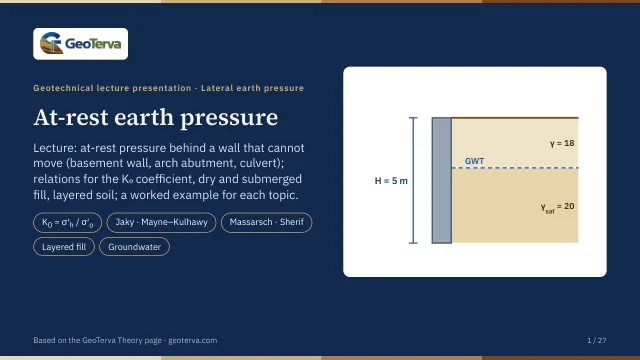
Lecture slides
Ready-made slides for lectures and self-study
The mechanism, the derivation, the equations and the figures of this page, in teaching order. Every slide links back to its chapter.
1Earth pressure at restK₀ = σ′h / σ′o.
A wall that cannot move — a basement wall braced by its floors, an abutment on piles, a culvert wall — leaves the soil behind it in the state it had in the ground before: at rest. The ratio of the horizontal to the vertical effective stress is then the coefficient of earth pressure at rest, K₀. If the wall moves away from the soil the pressure drops toward the active value; if it is pushed into the soil it rises toward the passive value (the other Lateral Earth Pressure modules). The movements needed are small for the active state and larger for the passive one:
| Soil | active, ΔLa/H | passive, ΔLp/H |
|---|---|---|
| Loose sand | 0.001–0.002 | 0.01 |
| Dense sand | 0.0005–0.001 | 0.005 |
| Soft clay | 0.02 | 0.04 |
| Stiff clay | 0.01 | 0.02 |
2The coefficient K₀Jaky, Sherif, Mayne & Kulhawy, Massarsch.
For coarse-grained soils Jaky (1944) gave the widely used
For a dense, compacted sand it underestimates the pressure, because compaction overconsolidates the fill. Sherif, Fang and Sherif (1984) recommended
with γd the compacted dry unit weight and γd(min) the dry unit weight in the loosest state. Mayne and Kulhawy (1982), from 171 soils, extended Jaky's equation to overconsolidated soils from clay to gravel:
OCR being the ratio of the preconsolidation pressure to the present effective overburden pressure. For normally consolidated fine-grained soils Massarsch (1979) related K₀ to the plasticity index. For an overconsolidated clay K₀ is commonly approximated by multiplying that value by √OCR — a correction that is not part of the relationship of Massarsch:
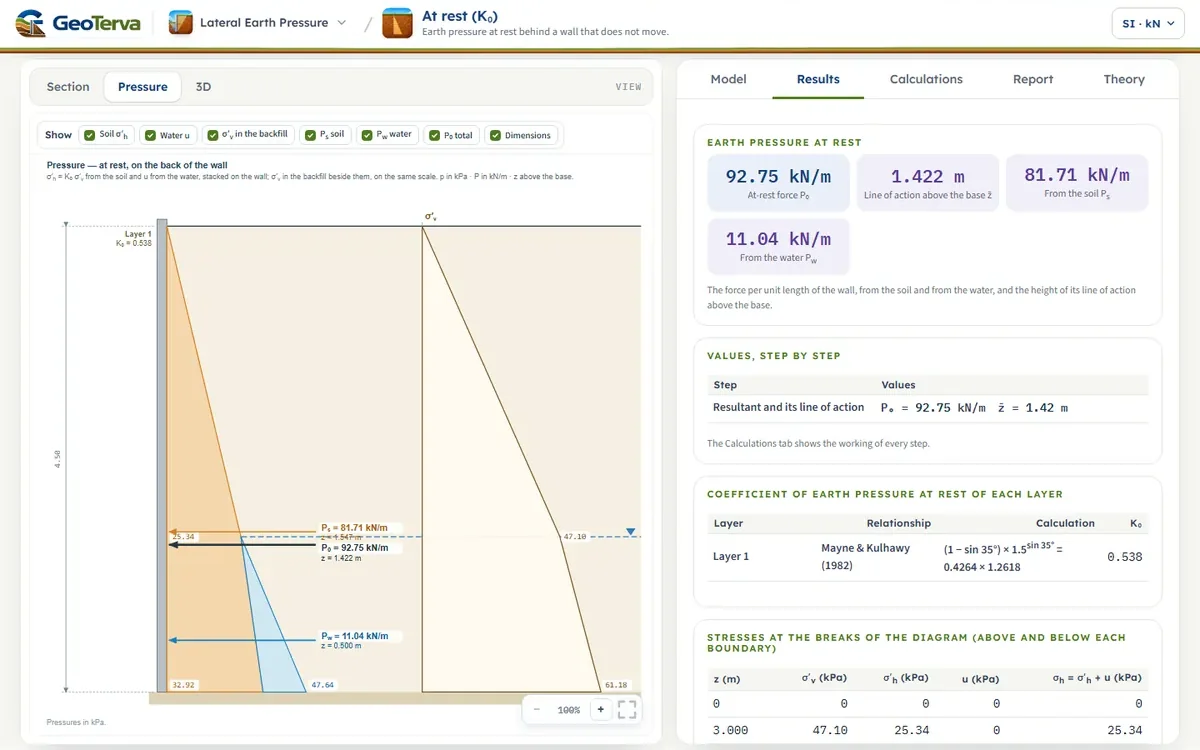
The module gives each layer its own K₀ by one of these relationships, or takes a value from a test.
3Dry backfillP₀ = ½K₀γH².
For a dry soil of unit weight γ the pressure grows linearly with depth, σ′h = K₀γz, and the force per unit length of the wall is the area of the triangle:
It acts at H/3 above the base. In a layered backfill σ′o is summed layer by layer and each layer takes its own K₀, so the diagram has a step at every boundary where K₀ changes.
4Partially submerged backfillEffective pressure plus water.
With the water table at the depth H₁ and no water in front of the wall, above it σ′h = K₀γz as before. Below it the effective vertical stress uses the submerged unit weight γ′ = γsat − γw:
and the water pushes on the wall with its full hydrostatic pressure, independent of K₀:
The force is the sum of the areas of the two diagrams:
Its line of action follows from the moments of the areas about the base. The water share is often the larger one below the table, since γw is much larger than K₀γ′.
5Worked examplesEvery number computed by the module’s own code.
First case. A wall 5 m high that cannot yield retains a sand with c′ = 0, φ′ = 30° and OCR = 2; γ = 18 kN/m³ above and γsat = 20 kN/m³ below a water table 2 m below the top. K₀ by Eq. (4):
The force is the sum of the areas of the diagrams (triangles and rectangles), and its line of action follows from their moments about the base:
Second case. A non-yielding wall 6 m high retains 3 m of sand (γ = 18 kN/m³, φ′ = 32°, OCR = 1) over 3 m of clay (γsat = 19 kN/m³, PI = 25 %, OCR = 2); the water table is at the top of the clay. The sand takes Jaky’s Eq. (2), the clay Eq. (5):
σ′h steps at the top of the clay, where K₀ changes; σ′o does not. Enter either case in the module — one layer for the first, two for the second — and its Calculations reach the same P₀ and z̄.
6ReferencesSources.
- Das, B.M. (2018). Principles of Geotechnical Engineering, 9th ed. Cengage Learning.
- Jaky, J. (1944). The coefficient of earth pressure at rest. Journal of the Society of Hungarian Architects and Engineers, 7, 355–358.
- Mayne, P.W. and Kulhawy, F.H. (1982). K₀–OCR relationships in soil. J. Geotech. Eng. Div., ASCE, 108(GT6), 851–872.
- Massarsch, K.R. (1979). Lateral earth pressure in normally consolidated clay. Proc. 7th European Conf. SMFE, Brighton, 2, 245–250.
- Sherif, M.A., Fang, Y.S. and Sherif, R.I. (1984). KA and K0 behind rotating and non-yielding walls. J. Geotech. Eng., ASCE, 110(GT1), 41–56.
From theory to your own design
Find the pressure at rest on your own wall in minutes
- K₀ by Jaky, Sherif, Mayne & Kulhawy or Massarsch, layer by layer
- The effective pressure, the water and the force with its height above the base
- Layers of different soil and a water table at any depth
- A clean calculation report, saved as a PDF. Works on your phone and in your browser