
On this page · 6 chapters
Rankine's active and passive pressure with a sloping granular backfill, and the general case of an inclined wall back after Chu (1991): the coefficients, the direction of the force and the failure wedge. The figures are computed from the equations.
 PDF
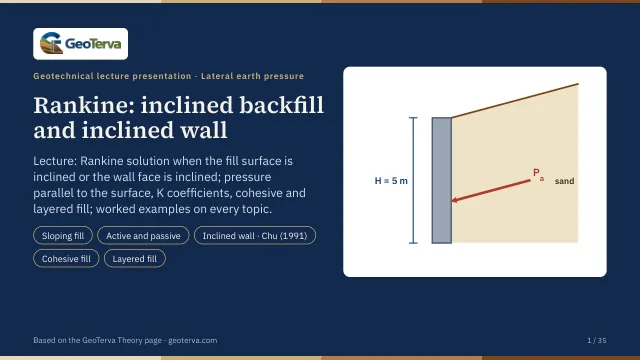
Lecture slides
Ready-made slides for lectures and self-study
The mechanism, the derivation, the equations and the figures of this page, in teaching order. Every slide links back to its chapter.
1Sloping backfillPressure parallel to the surface.
When the granular backfill (c′ = 0) behind a frictionless vertical wall slopes at α to the horizontal, the Rankine pressures are no longer horizontal: they act parallel to the ground surface, inclined at α, and still grow linearly with depth:
Both forces act at H/3 above the base, inclined at α. The root requires α ≤ φ′ — a slope steeper than φ′ could not stand. At α = 0 the equations return tan²(45 ∓ φ′/2).
| α | φ′ = 28° | φ′ = 30° | φ′ = 32° | φ′ = 34° | φ′ = 36° | φ′ = 38° | φ′ = 40° |
|---|---|---|---|---|---|---|---|
| 0° | 0.3610 | 0.3333 | 0.3073 | 0.2827 | 0.2596 | 0.2379 | 0.2174 |
| 5° | 0.3656 | 0.3372 | 0.3105 | 0.2855 | 0.2620 | 0.2399 | 0.2192 |
| 10° | 0.3802 | 0.3495 | 0.3210 | 0.2944 | 0.2696 | 0.2464 | 0.2247 |
| 15° | 0.4086 | 0.3729 | 0.3405 | 0.3108 | 0.2834 | 0.2581 | 0.2346 |
| 20° | 0.4605 | 0.4142 | 0.3739 | 0.3381 | 0.3060 | 0.2769 | 0.2504 |
| 25° | 0.5727 | 0.4936 | 0.4336 | 0.3847 | 0.3431 | 0.3070 | 0.2750 |
| α | φ′ = 28° | φ′ = 30° | φ′ = 32° | φ′ = 34° | φ′ = 36° | φ′ = 38° | φ′ = 40° |
|---|---|---|---|---|---|---|---|
| 0° | 2.770 | 3.000 | 3.255 | 3.537 | 3.852 | 4.204 | 4.599 |
| 5° | 2.715 | 2.943 | 3.196 | 3.476 | 3.788 | 4.136 | 4.527 |
| 10° | 2.551 | 2.775 | 3.022 | 3.295 | 3.598 | 3.936 | 4.316 |
| 15° | 2.284 | 2.502 | 2.740 | 3.002 | 3.293 | 3.615 | 3.977 |
| 20° | 1.918 | 2.132 | 2.362 | 2.612 | 2.886 | 3.189 | 3.526 |
| 25° | 1.434 | 1.664 | 1.894 | 2.135 | 2.394 | 2.676 | 2.987 |
2General caseInclined back and sloping backfill (Chu 1991).
Chu (1991) extended Rankine's solution to a frictionless wall whose back is inclined at θ to the vertical, with the granular backfill sloping at α (both positive as drawn). The active pressure at the depth z is
inclined at the angle β to the normal of the back:
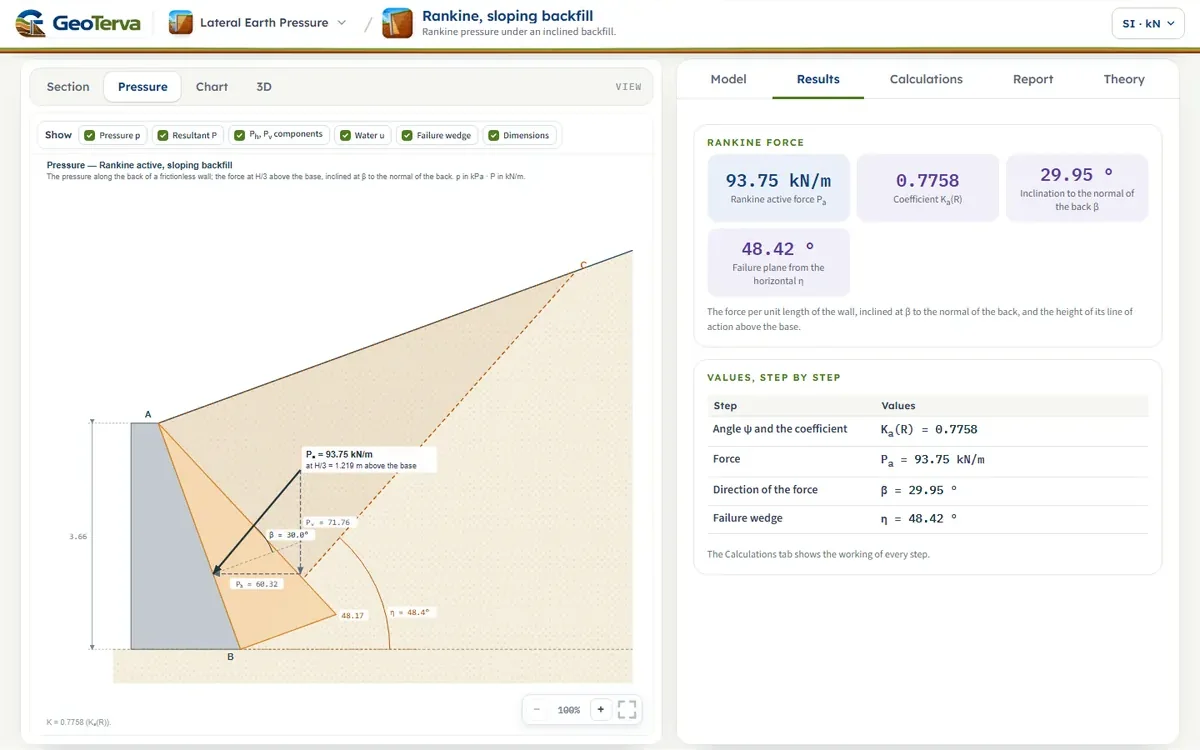
The force per unit length of the wall is Pₐ = ½γH²Kₐ₍R₎, with
and the failure wedge ABC is bounded by the plane BC at
For the passive case the signs change:
With θ = 0 the general coefficients reduce to Eq. (1) and Eq. (2), and β = α.
The back and the ground surface meet at 90° − |α − θ|. As that angle closes, the back runs along the slope — the wall lies on the slope (θ negative, α positive) or carries a thin sliver of soil (θ positive, α negative) — and the stress on it tends to that on a plane parallel to the surface, the weight of the soil above, rather than a lateral earth pressure. The module takes a back that meets the surface at 15° or more (|α − θ| ≤ 75°).
3Cohesive backfillA c′–φ′ soil behind a vertical back (Mazindrani and Ganjali 1997).
For a vertical frictionless wall (θ = 0) retaining a c′–φ′ backfill that slopes at α, Mazindrani and Ganjali (1997) give the active pressure at the depth z as
with
The coefficient changes with the depth through c′/γz, so the pressure is not a straight line. It is negative near the surface, down to the depth of the tension cracks
— the same depth as behind a level backfill, whatever the slope. For the passive case the sign before the root is +. With α = 0 the relationship is Rankine's σ′ₐ = Kₐγz − 2c′√Kₐ; with c′ = 0 it is Eq. (1).
The module integrates the curved pressure below zc (tension cracks) or over the whole height (no cracks). Mazindrani and Ganjali give no inclined back: with a cohesive layer the module needs θ = 0.
An undrained clay (φᵤ = 0, cᵤ, total stress) is the same relationship with φ′ = 0 and c′ = cᵤ: K′ₐ = 2cos²α − 2√(r² − sin²α cos²α) − 1 with r = cᵤ/γz, and σₐ = γz − 2cᵤ for α = 0. It exists only while the slope stands — the shear stress on the planes parallel to the surface, γz sin α cos α, may not exceed cᵤ — so the module checks it down to the heel of the wall; the tension cracks reach zc = 2cᵤ/γ.
4Layered backfillLayers parallel to the surface (this module).
The module also takes the backfill in layers parallel to the ground surface — a vertical borehole anywhere behind the wall meets them at the same thicknesses. Each layer is evaluated with the local parameters of the homogeneous solution for its own γ, φ′ and c′ (Chu for a granular layer, Mazindrani and Ganjali for a cohesive one), under the weight of the soil above it, σ′ᵥ = Σγᵢhᵢ (the hᵢ vertical) — a layered extension of the Rankine–Chu stress state adopted by the module. The pressure on the back is the single-layer relationship with γz replaced by σ′ᵥ:
for a granular layer, at the β of its own φ′ (with θ = 0 simply σ′ᵥK, at α); for a c′–φ′ layer behind a vertical back σ′ = σ′ᵥK′ cos α, with K′ from Eq. (11) and c′/σ′ᵥ in place of c′/γz. With the back inclined, a point of it at the depth z below the top of the wall lies d = z(1 + tan θ tan α) below the ground surface continued over the wall, and σ′ᵥ is taken there.
The pressure jumps at a boundary where the coefficient changes. The force of each layer is summed along the back as its component normal to the back, Nᵢ, and along it, Tᵢ; then P = √(N² + T²) with N = ΣNᵢ and T = ΣTᵢ, β = tan⁻¹(T/N), and the line of action crosses the back where the moment of the Nᵢ about the base is carried. The failure wedge rises from the heel along the slip planes of each layer — straight in a granular layer, curved in a cohesive one.
A surcharge q on the sloping surface (vertical, per unit area of the surface, as in the Coulomb module) is q/cos α per unit horizontal area and adds that to σ′ᵥ at every depth, as a layer of that weight; behind an inclined back it gives q cos θ/cos(θ − α) per unit vertical depth, as for Coulomb’s wedge, and for a level backfill σ′ₐ = Kₐ(q + γz). A water table is taken level, at zw below the top of the wall, with hydrostatic pore pressure: below it the layers weigh γ′ = γsat − γw in the column above a point of the back, each layer takes its coefficient under that σ′ᵥ, and u = γw(z − zw) acts normal to the back, adding to N only; an undrained layer is taken in total stress and the water counted apart. For a level backfill and a vertical back this is the classical Rankine treatment of a water table; behind a slope a level water table is part of the layered extension.
Chu (1991) and Mazindrani and Ganjali (1997) treat one homogeneous soil; the layered form is the module's engineering extension of the same stress state, not a closed-form layered solution of the literature, and the failure mechanism of a layered backfill may differ from the piecewise one drawn. For one granular layer it gives the closed form of Chu to within 10⁻⁸, and for one c′–φ′ layer that of Mazindrani and Ganjali.
5Worked exampleA wall with an inclined back behind a sloping backfill, in US units.
Worked example. H = 12 ft, α = +20°, θ = +20°, granular backfill γ = 115 lb/ft³, φ′ = 30°. Find Pₐ, its location and direction.
Pₐ acts 12/3 = 4 ft above the bottom of the wall, inclined at about 30° to the normal of the back. The module opens with this example in SI units (H = 3.658 m, γ = 18.07 kN/m³).
6ReferencesSources.
- Das, B.M. (2018). Principles of Geotechnical Engineering, 9th ed. Cengage Learning.
- Chu, S.C. (1991). Rankine analysis of active and passive pressures on dry sands. Soils and Foundations, 31(4), 115–120.
- Das, B.M. (2016). Principles of Foundation Engineering, 8th ed. Cengage Learning.
- Mazindrani, Z.H. and Ganjali, M.H. (1997). Lateral earth pressure problem of cohesive backfill with inclined surface. Journal of Geotechnical and Geoenvironmental Engineering, ASCE, 123(2), 110–112.
From theory to your own design
Work out your own sloping backfill in minutes
- The coefficient, the force, its inclination and the failure wedge, step by step
- An inclined back, a cohesive backfill and layers parallel to the surface
- The pressure diagram and the wedge drawn to scale
- A clean calculation report, saved as a PDF. Works on your phone and in your browser