
On this page · 6 chapters
The vertical stress below a flexible strip load of finite width and infinite length, derived by integrating the line-load solution. The figures are computed from the equations.
 PDF
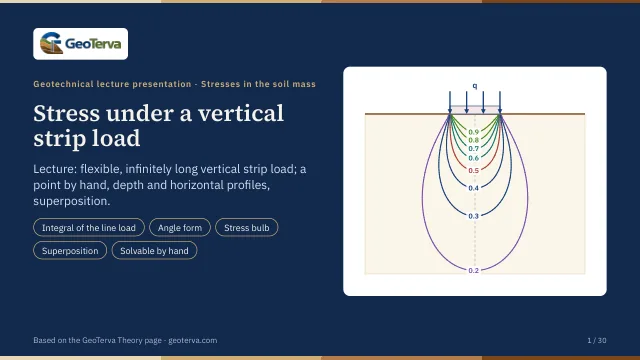
Lecture slides
Ready-made slides for lectures and self-study
The mechanism, the derivation, the equations and the figures of this page, in teaching order. Every slide links back to its chapter.
1Scope and assumptionsFinite width, infinite length.
A long footing, a road or an embankment crest, a wall base — many loads are long in one direction and of finite width in the other. The strip load models them: a flexible band of width B and infinite length carrying a uniform vertical pressure q. The stress it causes is the same in every cross section, so the problem is two-dimensional (plane strain).
- A flexible strip — the pressure stays q across the width whatever the settlement; a rigid footing would redistribute it.
- The soil is a homogeneous, isotropic, linearly elastic half-space.
- Δσz is an increase caused by the load only; the overburden pressure is added separately.
2DerivationIntegrating the line load over the width.
The elemental strip of width dr carries q dr per unit length and acts as a line load. Its horizontal distance to A is x − r, so the line-load solution gives
The whole strip is the sum of these line loads, r running from −B/2 to +B/2:
With u = x − r and the standard integral of 1/(u² + z²)², the antiderivative is (q/π)[tan⁻¹(u/z) + z u/(u² + z²)]; between u = x − B/2 and u = x + B/2 it gives
Three remarks go with it:
- The arctangents are in radians.
- Δσz is the same at +x and −x: the strip is symmetric about its centre line.
- As written, the equation holds for x ≥ B/2. For 0 ≤ x < B/2 the first arctangent turns negative and must be replaced by π + tan⁻¹[z/(x − B/2)]; exactly at x = B/2 it is π/2.
3The angle formΔσz = (q/π)[α + sin α cos(α + 2δ)].
The same result is often written with the angles of the figure. With θ measured from the surface, the first two terms of the equation are the angle α and the third collects into one trigonometric term:
where δ is the angle between the vertical and the line from A to the nearer edge, positive when A lies outside the strip and negative when it lies under it. The form shows at once that the stress depends only on the angles — on x/B and z/B — and never exceeds q: on the surface under the strip α = π and Δσz = q; beside it α = 0.
4Pressure bulb and tableContours of Δσz/q.
Under the centre the stress falls to one half of q at about z = 1.1B, to one fifth at about 3.1B and to one tenth only at about 6.3B; the lines 0.6–0.9 crowd under the strip near the surface — the familiar “pressure bulb”. The lines are the same for every strip when the distances are divided by B.
| 2z/B | 2x/B = 0 | 2x/B = 0.5 | 2x/B = 1 | 2x/B = 1.5 | 2x/B = 2 |
|---|---|---|---|---|---|
| 0.00 | 1.000 | 1.000 | 0.500 | 0.000 | -0.000 |
| 0.20 | 0.997 | 0.988 | 0.500 | 0.011 | 0.002 |
| 0.50 | 0.959 | 0.902 | 0.497 | 0.089 | 0.019 |
| 1.00 | 0.818 | 0.735 | 0.480 | 0.214 | 0.084 |
| 1.50 | 0.668 | 0.607 | 0.448 | 0.271 | 0.146 |
| 2.00 | 0.550 | 0.510 | 0.409 | 0.288 | 0.185 |
| 3.00 | 0.396 | 0.379 | 0.334 | 0.274 | 0.211 |
| 4.00 | 0.306 | 0.298 | 0.275 | 0.242 | 0.205 |
| 5.00 | 0.248 | 0.244 | 0.231 | 0.212 | 0.188 |
5Worked exampleEvery number computed by the module’s own code.
Since x = 1 m < B/2 = 2 m, the first arctangent takes the correction π:
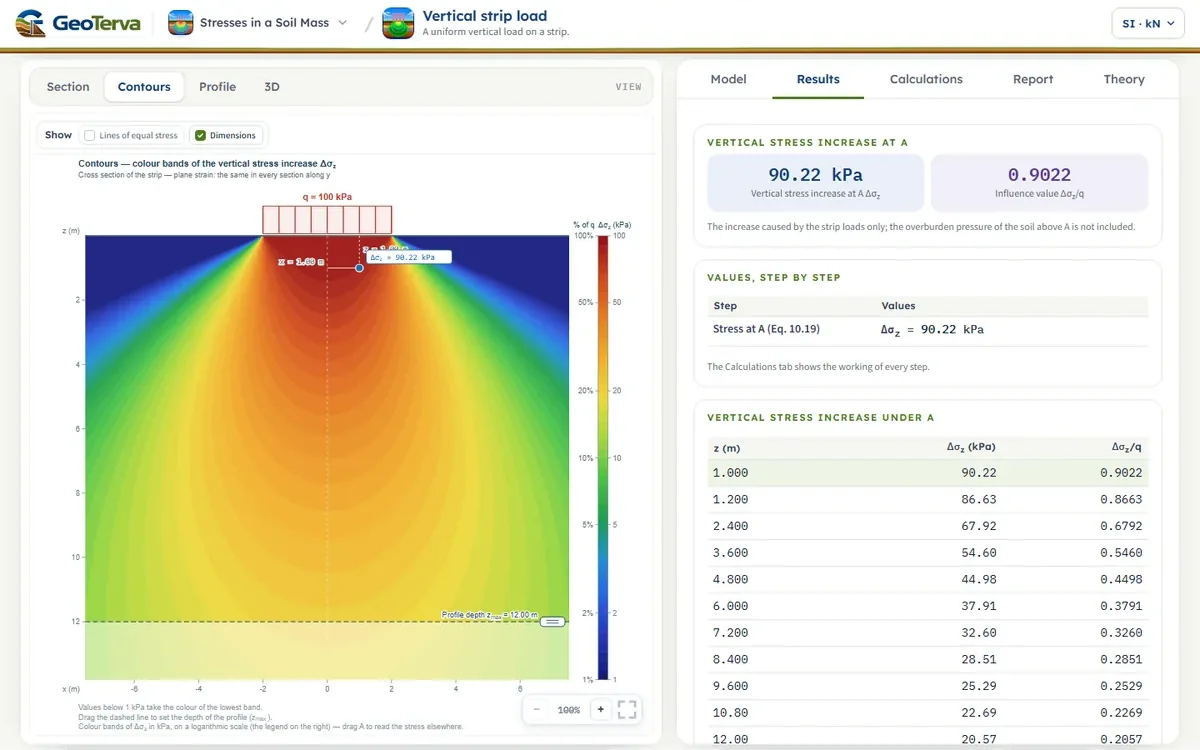
The table above (2x/B = 2z/B = 0.5) gives the same 0.902. The module opens with this example. Further strips, each with its own q, B and centre line, are put in one by one with Add strip load (up to eight); the strips may not overlap — two may meet at an edge — and, the soil being elastic, the stress of each strip is found with its own x, the distance of A from its centre line, and the stresses add.
6ReferencesSources.
- Das, B.M. (2018). Principles of Geotechnical Engineering, 9th ed. Cengage Learning.
From theory to your own design
Find the stress below your own strip load in minutes
- The vertical stress increase at any point below one or several strips
- Lines of equal stress and a depth profile
- Drag a strip or its edges on the section
- A clean calculation report, saved as a PDF. Online: nothing to install, no dongle, on a phone, a tablet or a PC