
On this page · 4 chapters
Westergaard's solution for the vertical stress below a point load in soil reinforced by thin rigid horizontal layers, compared with Boussinesq's. The figures are computed from the equations.
 PDF
Lecture slides
Ready-made slides for lectures and self-study
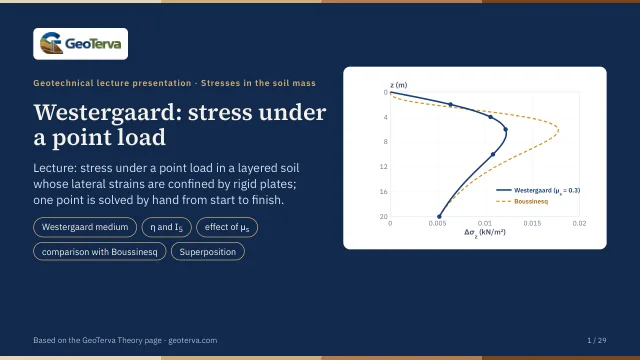
The mechanism, the derivation, the equations and the figures of this page, in teaching order. Every slide links back to its chapter.
1Westergaard's mediumSoil with rigid horizontal reinforcements.
Every Boussinesq-based solution of this program integrates Boussinesq's point-load solution for a homogeneous, isotropic half-space. Many soils are layered instead: a clay with thin seams of sand, say, whose horizontal deformation is restrained by the stiffer layers. Westergaard (1938) solved the point load for an idealisation of such a soil — an elastic medium with numerous thin, rigid horizontal sheets that permit no lateral strain.
2The solutionΔσz = (P/z²) I5.
The vertical stress increase at A is
where μs is Poisson's ratio of the soil between the rigid layers, r = √(x² + y²), and
Rewritten with an influence value, as for Boussinesq's I1:
Under the load the Westergaard stress is lower than Boussinesq's for μs = 0 (1/π = 0.318 against 3/2π = 0.477) — the rigid sheets spread the load sideways — and grows as μs increases; at μs = 0.5, η = 0 and the solution breaks down.
| r/z | μs = 0 | μs = 0.2 | μs = 0.4 |
|---|---|---|---|
| 0 | 0.3183 | 0.4244 | 0.9549 |
| 0.1 | 0.3090 | 0.4080 | 0.8750 |
| 0.2 | 0.2836 | 0.3646 | 0.6916 |
| 0.3 | 0.2483 | 0.3074 | 0.4997 |
| 0.4 | 0.2099 | 0.2491 | 0.3480 |
| 0.5 | 0.1733 | 0.1972 | 0.2416 |
| 0.6 | 0.1411 | 0.1547 | 0.1700 |
| 0.8 | 0.0925 | 0.0953 | 0.0897 |
| 1 | 0.0613 | 0.0604 | 0.0516 |
| 1.5 | 0.0247 | 0.0229 | 0.0173 |
| 2 | 0.0118 | 0.0107 | 0.0076 |
| 3 | 0.0038 | 0.0034 | 0.0023 |
| 5 | 0.0009 | 0.0008 | 0.0005 |
3Worked exampleEvery number computed by the module’s own code.
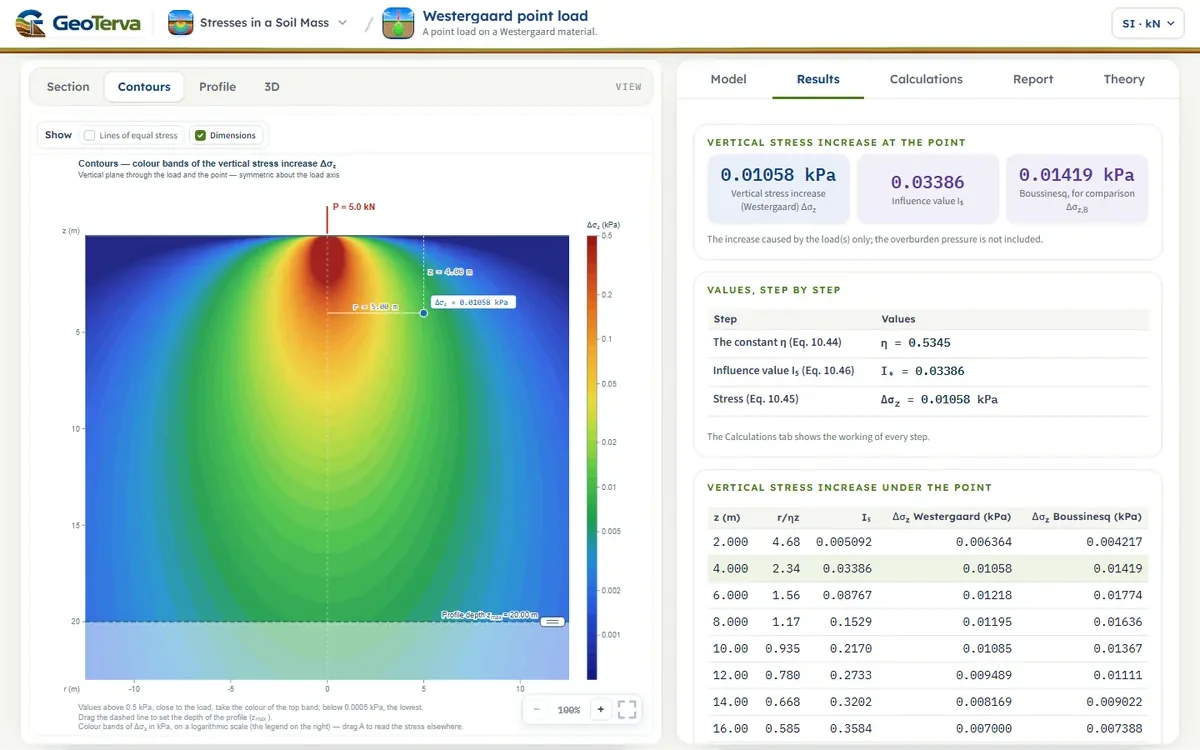
The point load P = 5 kN at r = 5 m — the load of the Boussinesq point-load example — on a Westergaard material with μs = 0.3. From the equation, η = √[(1 − 0.6)/(2 − 0.6)] = 0.5345.
| z (m) | r/ηz | I5 | Westergaard | Boussinesq |
|---|---|---|---|---|
| 2 | 4.677 | 0.0051 | 0.0064 | 0.0042 |
| 4 | 2.339 | 0.0339 | 0.0106 | 0.0142 |
| 6 | 1.559 | 0.0877 | 0.0122 | 0.0177 |
| 10 | 0.935 | 0.2170 | 0.0108 | 0.0137 |
| 20 | 0.468 | 0.4140 | 0.0052 | 0.0051 |
At this distance from the load the Westergaard stress is smaller at moderate depths and the two come together deeper down. The module opens with this example at z = 4 m. Further point loads, each at its own position on the ground, are put in one by one with Add point load (up to eight, no two at the same position); the Westergaard medium is elastic, so the stress of each load is found with its own distance r from the point and the stresses add.
4ReferencesSources.
- Das, B.M. (2018). Principles of Geotechnical Engineering, 9th ed. Cengage Learning.
- Westergaard, H.M. (1938). A problem of elasticity suggested by a problem in soil mechanics: soft material reinforced by numerous strong horizontal sheets. In Contributions to the Mechanics of Solids, Stephen Timoshenko 60th Anniversary Volume. Macmillan, New York, 268–277.
From theory to your own design
Find the Westergaard stress for your own loads in minutes
- The vertical stress increase at a point below one or several point loads
- The comparison with Boussinesq
- The depth profile
- A clean calculation report, saved as a PDF. Online: nothing to install, no dongle, on a phone, a tablet or a PC