
On this page · 8 chapters
Passive earth pressure with a curved failure surface: the log-spiral trial wedge of Terzaghi & Peck computed directly, with Lancellotta, Shields & Tolunay, Zhu & Qian, Sokolowskiĭ and Caquot & Kerisel for comparison, and the module’s generalised wedge for an inclined back, a sloping surface, layers, water and a surcharge.
 PDF
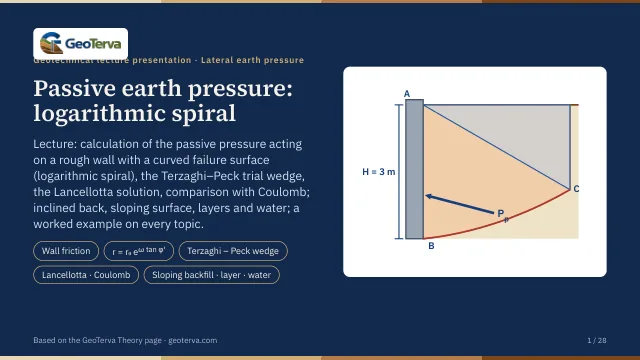
Lecture slides
Ready-made slides for lectures and self-study
The mechanism, the derivation, the equations and the figures of this page, in teaching order. Every slide links back to its chapter.
1Wall friction and the failure surfaceWhy passive pressure needs a curved surface.
Coulomb's plane failure surface is a fair approximation for active pressure, but for passive pressure with a rough wall it overestimates the resistance, and the more so the larger the wall friction — on the unsafe side.
When a wall is pushed into a granular backfill, the soil in front of it rises relative to the wall. The wall then shears the soil downward (positive wall friction) and the passive force is inclined at δ′ below the normal of the wall. The failure surface is curved near the heel (BC) and straight near the surface (CD, at 45° − φ′/2 to the horizontal); the zone ACD is in Rankine's passive state.
2The logarithmic spiralThe property that makes it convenient.
The curved part BC is taken as a logarithmic spiral about a centre O:
where r₀ is the radius at ω = 0. Its useful property: every radius meets the curve at φ′ to the normal. The resultant of the normal and shear forces on a failure surface in a granular soil is also at φ′ to the normal, so on a log spiral it lies on a radius and passes through O — it drops out of a moment equation about O.
is the area of a sector between r₀ and r₁; the module integrates the wedge area and its centroid numerically.
3The log-spiral trial wedgeTerzaghi & Peck.
The trial-wedge procedure of Terzaghi & Peck (1967) for a vertical wall AB of height H:
- Draw line AC from the top of the wall at 45° − φ′/2 below the surface, and choose a point C on it.
- Find the centre O on line AC (extended if necessary) such that a spiral with r₀ = OB passes through C with r₁ = OC = r₀ exp(ω tan φ′), ω = angle BOC.
- The vertical face CC′ (d = depth of C) carries the Rankine passive force of the zone ACD, horizontal at d/3 above C:
Moments about O of the weight W of ABCC′, of Pd and of the wall force P (at H/3, δ′ below the normal) — F passes through O — give
The procedure is repeated for several positions of C; the smallest trial force is the passive force, and
Kp of this procedure is usually read from charts; the module carries it out numerically for the given φ′ and δ′. With δ′ = 0 the spiral flattens into a plane and Kp is Rankine's tan²(45° + φ′/2).
4Coefficient of passive pressureLog spiral and the other solutions.
Other solutions for a vertical wall and a level granular backfill, all written as Pp = ½KpγH²:
- Shields & Tolunay (1973) — the method of slices on the same wedge; tabulated.
- Lancellotta (2002) — the lower-bound theorem of plasticity, in closed form (below).
- Sokolowskiĭ (1965) — the method of characteristics; tabulated.
- Zhu & Qian (2000) — triangular slices: Kp = Kp(δ′=0) R, with Kp(δ′=0) and the ratio R tabulated.
(2θ in radians; the bracket is the coefficient of the horizontal component, K′p = Kp cos δ′.) Being a lower bound, Lancellotta's value lies a little below the log-spiral wedge, which is an upper bound; the method of characteristics lies between, very close to the log spiral:
| φ′ | δ′ | log spiral | Sokolowskiĭ | Lancellotta | Coulomb |
|---|---|---|---|---|---|
| 20° | 10° | 2.56 | 2.55 | 2.52 | 2.64 |
| 20° | 20° | 3.07 | 3.04 | 2.87 | 3.53 |
| 30° | 15° | 4.61 | 4.62 | 4.44 | 4.98 |
| 30° | 30° | 6.68 | 6.55 | 5.80 | 10.10 |
| 40° | 20° | 9.67 | 9.68 | 8.92 | 11.77 |
| 40° | 40° | 18.86 | 18.27 | 14.39 | 92.59 |
5Caquot & KeriselCharts for inclined backs and sloping backfills.
Caquot & Kerisel (1948) tabulated passive coefficients with log-spiral failure surfaces for an inclined wall back with a level backfill (Pp = ½γH₁²Kp with H₁ the length of the back) and for a vertical wall with a sloping backfill. The charts are drawn for δ′ = φ′; other wall friction is taken with a reduction factor R′:
For φ′ = 30° and δ′/φ′ = 0.5, R′ = 0.746: the coefficient is then 0.746 of that for δ′ = φ′.
6Inclined back, sloping surface, layersThe generalised wedge of the module, with water and a surcharge.
The module carries the wedge of Terzaghi & Peck to a back at θ from the vertical and a surface at α. The zone between the line AC and the surface is taken in the passive Rankine state of the sloping surface: its two slip lines, AC and CD, lie at ±(45° − φ′/2) from its major principal stress (for a level surface, ±(45° − φ′/2) from the horizontal), and its thrust on the vertical face below C is parallel to the surface. The centre O of the spiral lies on the line AC — beyond A as in the wedge of Terzaghi & Peck, or beyond C where a falling surface or the back turn the spiral the other way — and the spiral turns the way that is tangent to CD at C. A spiral that leaves the soil, or that would turn the soil the wrong way (the wall force must drive the rotation that lifts the soil off the spiral), is not a mechanism; the plane BC, with O at infinity, is the limit of both. The parts of the soil weight and of a surcharge are each made smallest by their own position of C, as Terzaghi does for the parts of the passive force:
the weight part at H/3, the surcharge part at H/2 above the base. Coulomb’s plane is also a mechanism: the smaller coefficient of the two is taken for each part. For a vertical back and a level surface it is the wedge of Terzaghi & Peck; where the wall friction equals the inclination of Rankine’s stress on the back it gives Rankine’s passive force of the slope exactly; Kpq for a level surface lies within about 3 % of Lancellotta’s solution, which is exact for a weightless soil.
Layers with level boundaries each take their own Kpγ and Kpq with the θ and α of the wall; the overburden of the layers above (and qe) acts on a layer as a surcharge, its own weight through Kpγ. A level water table gives γ′ = γsat − γw below it, and u acts normal to the back:
per unit length of the back, inclined at the δ′ of the layer to its normal. This is the module’s engineering extension of the wedge, not a closed-form solution of the literature.
| Case | Kₚ, chart | Kₚ, module | Difference |
|---|---|---|---|
| α/φ′ = 0.4, φ′ = 30° | 10.60 | 10.22 | −3.6 % |
| α/φ′ = 0.8, φ′ = 30° | 15.10 | 14.51 | −3.9 % |
| α/φ′ = −0.2, φ′ = 35° | 8.01 | 7.80 | −2.7 % |
| α/φ′ = −0.6, φ′ = 25° | 2.42 | 2.36 | −2.4 % |
| θ = 20°, φ′ = 30° | 3.84 | 3.82 | −0.6 % |
| θ = 30°, φ′ = 30° | 2.76 | 2.80 | 1.6 % |
| θ = −10°, φ′ = 30° | 7.84 | 8.67 | 10.6 % |
7Worked exampleA vertical wall, by each solution.
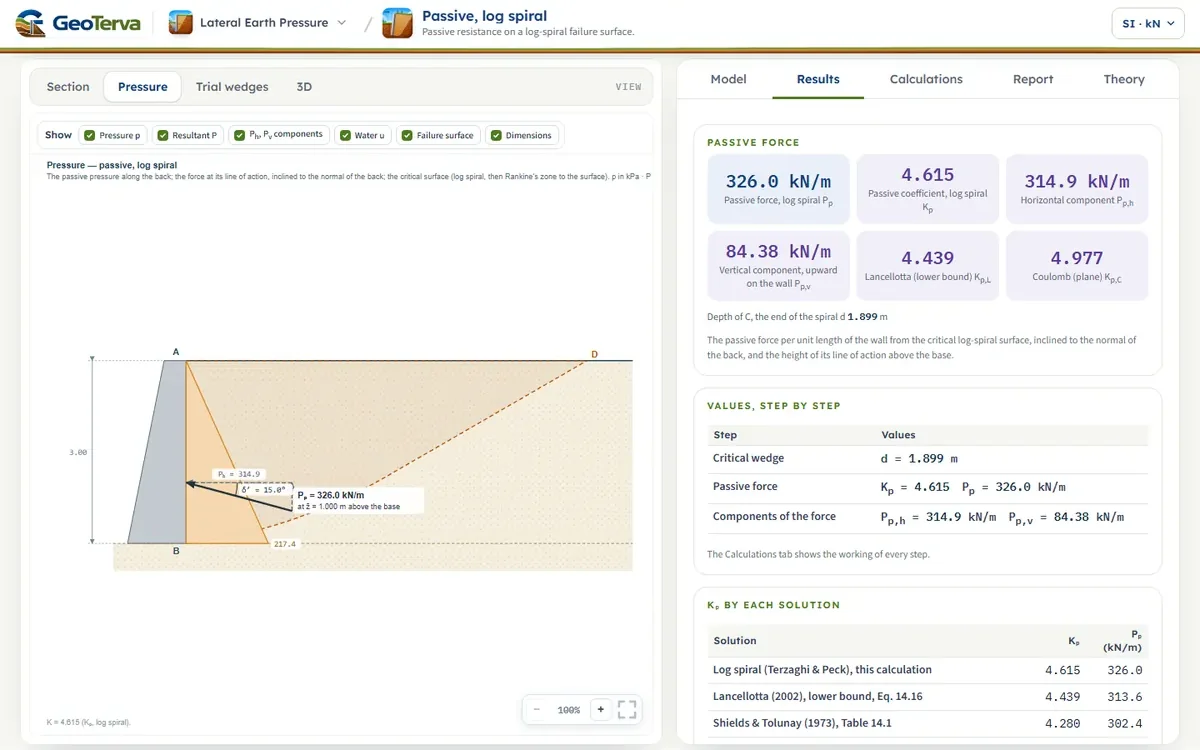
A vertical wall H = 3 m with a level granular backfill, γ = 15.7 kN/m³, φ′ = 30°, δ′ = 15°. Estimate Pp by each of the solutions above.
| Solution | Kₚ | Pₚ (kN/m) |
|---|---|---|
| Coulomb (1776), plane surface | 4.977 | 351.6 |
| Terzaghi & Peck (log spiral) | 4.615 | 326.0 |
| Shields & Tolunay (1973) | 4.280 | 302.4 |
| Zhu & Qian (2000), 3.00 × 1.525 | 4.575 | 323.2 |
| Lancellotta (2002) | 4.439 | 313.6 |
The plane surface of Coulomb gives the largest value; the curved-surface solutions cluster between 302 and 326 kN/m. The module opens with this example.
8ReferencesSources.
- Das, B.M. (2018). Principles of Geotechnical Engineering, 9th ed. Cengage Learning.
- Terzaghi, K. and Peck, R.B. (1967). Soil Mechanics in Engineering Practice, 2nd ed. Wiley, New York.
- Shields, D.H. and Tolunay, A.Z. (1973). Passive pressure coefficients by method of slices. Journal of the Soil Mechanics and Foundations Division, ASCE, 99(SM12), 1043–1053.
- Lancellotta, R. (2002). Analytical solution of passive earth pressure. Géotechnique, 52(8), 617–619.
- Sokolowskiĭ, V.V. (1965). Statics of Granular Media. Pergamon, London.
- Zhu, D.Y. and Qian, Q. (2000). Determination of passive earth pressure coefficients by the method of triangular slices. Canadian Geotechnical Journal, 37(2), 485–491.
- Caquot, A. and Kerisel, J. (1948). Tables for the Calculation of Passive Pressure, Active Pressure and Bearing Capacity of Foundations. Gauthier-Villars, Paris.
- Das, B.M. (2016). Principles of Foundation Engineering, 8th ed. Cengage Learning.
From theory to your own design
Find the passive resistance on your own wall in minutes
- The critical log-spiral surface, the passive force and its components, step by step
- The coefficient beside the solutions of Lancellotta, Shields & Tolunay, Zhu & Qian and Caquot & Kerisel
- An inclined back, a sloping surface, layers, a water table and a surcharge
- A clean calculation report, saved as a PDF. Works on your phone and in your browser