
On this page · 6 chapters
Coulomb's active and passive earth pressure: the trial wedge with wall friction, the coefficients for an inclined back and a sloping granular backfill, and the critical wedge. The figures are computed from the equations.
 PDF
Lecture slides
Ready-made slides for lectures and self-study
The mechanism, the derivation, the equations and the figures of this page, in teaching order. Every slide links back to its chapter.
1The trial wedgePlane failure surface, wall friction.
Coulomb (1776) treated the soil behind a wall as a rigid wedge sliding on a plane through the heel, and — unlike Rankine — took the friction between the soil and the wall into account. For a granular backfill (τf = σ′ tan φ′) three forces act on a trial wedge ABC per unit length of the wall:
- W — the weight of the wedge;
- F — the resultant of the normal and shear forces on the trial failure plane BC, inclined at φ′ to its normal;
- Pₐ — the force from the wall, inclined at δ′ (the angle of wall friction) to the normal of the back AB.
With the back at θ to the vertical, the backfill at α and the trial plane BC at β to the horizontal, the law of sines in the force polygon gives
2Coulomb's active pressureThe maximum of the trial wedges.
Only β is unknown in Eq. (2). The wall must hold the most dangerous wedge, so Coulomb's active force is the maximum of Pₐ(β), dPₐ/dβ = 0. Solving it gives
With α = θ = δ′ = 0 it becomes (1 − sin φ′)/(1 + sin φ′), Rankine's coefficient. The force acts at H/3 above the base, inclined at δ′ to the normal of the back. Wall friction reduces the active force:
| φ′ | δ′ = 0° | δ′ = 5° | δ′ = 10° | δ′ = 15° | δ′ = 20° | δ′ = 25° |
|---|---|---|---|---|---|---|
| 28° | 0.3610 | 0.3448 | 0.3330 | 0.3251 | 0.3203 | 0.3186 |
| 30° | 0.3333 | 0.3189 | 0.3085 | 0.3014 | 0.2973 | 0.2959 |
| 32° | 0.3073 | 0.2945 | 0.2852 | 0.2791 | 0.2755 | 0.2745 |
| 34° | 0.2827 | 0.2714 | 0.2633 | 0.2579 | 0.2549 | 0.2542 |
| 36° | 0.2596 | 0.2497 | 0.2426 | 0.2379 | 0.2354 | 0.2350 |
| 38° | 0.2379 | 0.2292 | 0.2230 | 0.2190 | 0.2169 | 0.2167 |
| 40° | 0.2174 | 0.2098 | 0.2045 | 0.2011 | 0.1994 | 0.1995 |
| 42° | 0.1982 | 0.1916 | 0.1870 | 0.1841 | 0.1828 | 0.1831 |
3Coulomb's passive pressureThe minimum of the trial wedges.
Pushed into the soil, the wall lifts a wedge; the reaction on the failure plane and the wall force turn to the other side of their normals. The passive force is the minimum over the trial wedges:
For θ = α = δ′ = 0 it is tan²(45 + φ′/2), Rankine's Kₚ. Wall friction increases the passive force, and quickly:
| φ′ | δ′ = 0° | δ′ = 5° | δ′ = 10° | δ′ = 15° | δ′ = 20° |
|---|---|---|---|---|---|
| 15° | 1.698 | 1.901 | 2.131 | 2.403 | 2.735 |
| 20° | 2.040 | 2.313 | 2.635 | 3.029 | 3.525 |
| 25° | 2.464 | 2.833 | 3.285 | 3.855 | 4.597 |
| 30° | 3.000 | 3.505 | 4.143 | 4.977 | 6.105 |
| 35° | 3.690 | 4.391 | 5.309 | 6.555 | 8.324 |
| 40° | 4.599 | 5.593 | 6.946 | 8.872 | 11.771 |
4Layers, water and surchargeA layered backfill with a water table and a surcharge (this module).
A surcharge q on the backfill surface (vertical, per unit area of the sloping surface) adds its weight to every trial wedge in the same proportion as the soil, so the critical wedge does not change and Coulomb’s coefficient stays the same. It may be written as an equivalent unit weight; per unit vertical depth it is the vertical stress
added at every depth, so that P = ½K γH² + K qe H, the first part at H/3, the second at H/2 above the base.
The module also takes the backfill in layers, their boundaries level and their thicknesses measured vertically at the back from its top A, each with its own γ, φ′ and wall friction δ′. Each layer takes its own Coulomb coefficient under the effective vertical stress below A,
per unit length of the back, inclined at the δ′ of the layer to its normal; the pressure jumps at a boundary where K changes. A level water table at zw below A, with hydrostatic pore pressure, makes the layers weigh γ′ = γsat − γw below it, and u = γw(z − zw) acts normal to the back — the treatment of Rankine’s pressure. The forces of the layers and of the water are summed as components normal to the back and along it; the line of action follows from the moments of the normal components about the base.
A cohesive layer (c′ > 0) takes the cohesion term in the form of Rankine’s, σ′ = Kσ′ᵥ − 2c′√K (active) or + 2c′√K (passive), with the Coulomb coefficient K of the layer; the adhesion between the wall and the soil is neglected, and near the top of the layer the negative (tension) part is left out with cracks or counted in full. For δ′ = 0 with a level backfill and a vertical back this is Rankine’s c′–φ′ solution.
Coulomb’s wedge is a single plane through one soil; the layered form is the module’s engineering extension of it, not a closed-form layered solution of the literature. For one soil it is Coulomb’s closed form; with δ′ = 0, a level backfill and a vertical back it is Rankine’s layered solution. The critical plane of each layer, drawn from the heel through the layers, is a piecewise approximation of the mechanism.
5Worked exampleActive force on a wall with a sloping backfill, an inclined back and wall friction.
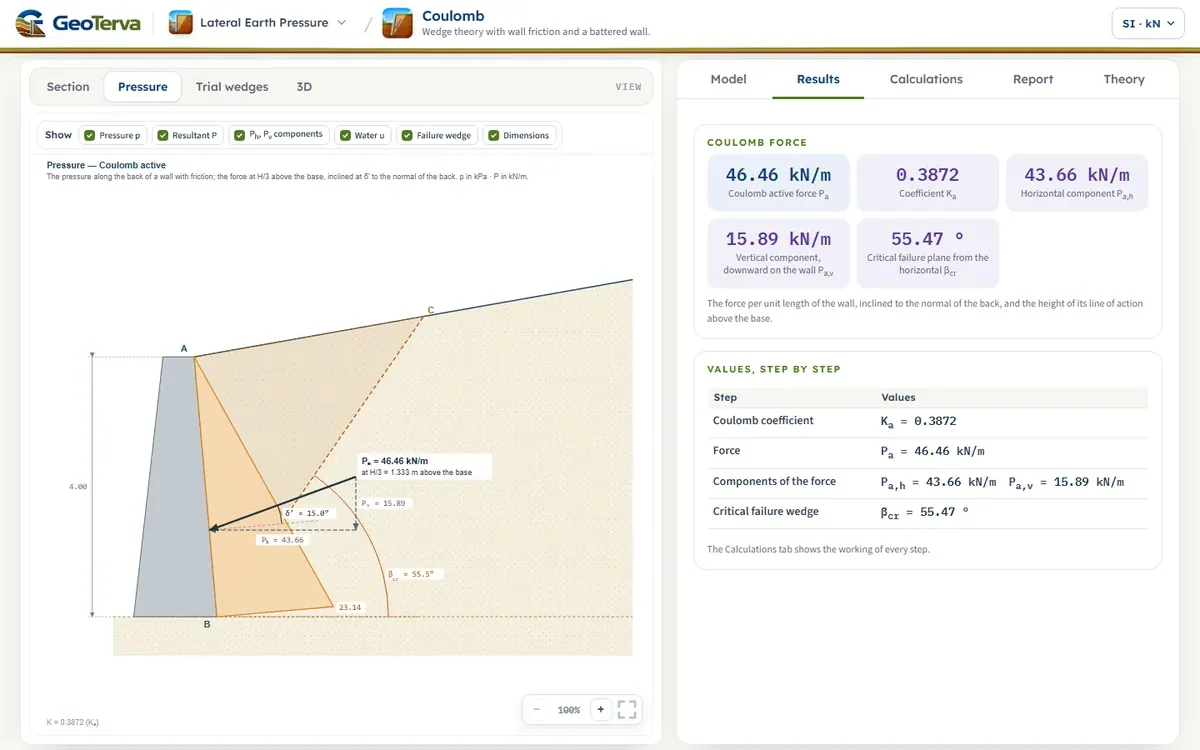
Worked example. α = 10°, θ = 5°, H = 4 m, γ = 15 kN/m³, φ′ = 30°, δ′ = 15° (δ′/φ′ = ½). Estimate Pₐ, its direction and location.
The force acts H/3 = 1.33 m above the bottom of the wall, inclined at 15° = δ′ to the normal of the back. The trial wedges of Figure 2 reach this maximum at β ≈ 55.5°. The module opens with this example.
6ReferencesSources.
- Das, B.M. (2018). Principles of Geotechnical Engineering, 9th ed. Cengage Learning.
- Coulomb, C.A. (1776). Essai sur une application des règles de Maximis et Minimis à quelques problèmes de statique relatifs à l'architecture. Mémoires de Mathématique et de Physique, Académie Royale des Sciences, Paris, 7, 343–382.
- Das, B.M. (2016). Principles of Foundation Engineering, 8th ed. Cengage Learning — a surcharge on a sloping backfill.
From theory to your own design
Find the Coulomb force on your own wall in minutes
- The critical wedge, the force, its components and its line of action, step by step
- Wall friction, an inclined back and a sloping backfill, active or passive
- Layers of different soil, a water table and a surcharge
- A clean calculation report, saved as a PDF. Works on your phone and in your browser