
On this page · 5 chapters
The Hansen tool in this section already handles a tilted footing base and sloping ground, on top of everything Meyerhof's equation offers. This page covers the one remaining refinement in this family: Vesic's (1973) observation that an inclined load does not affect a footing the same way regardless of the footing's own proportions and which way the load leans.
 PDF
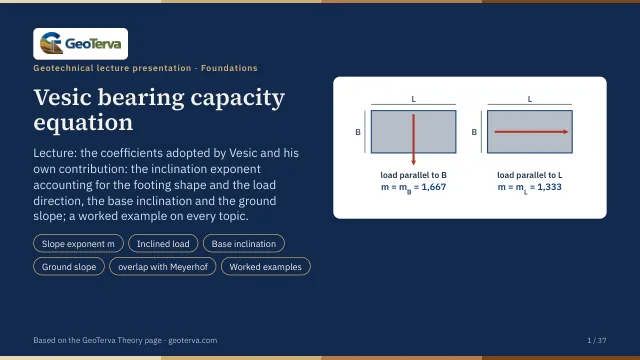
Lecture slides
Ready-made slides for lectures and self-study
The mechanism, the derivation, the equations and the figures of this page, in teaching order. Every slide links back to its chapter.
1What Vesic actually contributed
It would be easy to assume Vesic's equation is entirely his own, the way Hansen's base-tilt and ground-slope factors are entirely his. It is not, and Vesic himself did not claim otherwise: he adopted De Beer's shape factors and Hansen's depth factors without modification, and the Nγ already used throughout the Meyerhof tool in this section is his. What Vesic added was a refinement to the inclination factors — and, separately, his own functional form for the base-tilt factors.
This is exactly Hansen's equation, term for term — the difference is entirely inside ic, iq, iγ, bc, bq and bγ, which is why this tool reuses the Meyerhof tool's Nc/Nq/Nγ, shape and depth factors directly rather than recomputing anything new for them.
The depth factors are Hansen's, as the second source restates them, with k = Df/B, or tan⁻¹(Df/B) in radians once Df/B exceeds 1. For φ > 0 the cohesion factor follows from Fqd; the simpler Fcd = 1 + 0.4k is its form at φ = 0 only, where Fqd = 1. (Until 2026-09-19 the module used 1 + 0.4k at every φ, which overstated the cohesion term of a c–φ soil.)
2An exponent that knows the footing's shape and the load's direction
Meyerhof's inclination factors use a fixed exponent (2 for Fci/Fqi, matched to Fγi in a different form entirely); Hansen's use a fixed exponent of 5 for both. Neither asks whether the footing is square or a long strip, or which way the horizontal load is actually pushing relative to the footing's own long and short sides. Vesic's do:
| B/L | m — load ∥ B | m — load ∥ L |
|---|---|---|
| 0.0 | 2.000 | 1.000 |
| 0.2 | 1.833 | 1.167 |
| 0.4 | 1.714 | 1.286 |
| 0.6 | 1.625 | 1.375 |
| 0.8 | 1.556 | 1.444 |
| 1.0 | 1.500 | 1.500 |
h and v here are the applied horizontal and vertical bearing pressure of ONE load case, H/A and V/A, exactly as in the Hansen tool — not the ultimate capacity being solved for; in this module v is qapplied, the vertical gross pressure at the base, so the inclination factors and the check of the footing use the same load (with h > 0 the module needs qapplied). The physical picture is the same one Hansen's factors capture (a load closer to the base's full sliding resistance leaves less bearing capacity to offer); Vesic's contribution is making the rate at which that happens depend on the footing's own proportions. As in the Hansen tool, ic is held at zero once the formula would turn negative, the module warns when h exceeds the base's sliding resistance v·tan φ + c, and it gives no bearing capacity at all once h ≥ v + c·cot φ.
At φ = 0 the cohesion factor takes its own form, and the module stops once h ≥ c:
3Base tilt and ground slope — Vesic's own factors
Vesic (1975) also proposed his own base-tilt and ground-slope factors, independently of Hansen's. As with his inclination factors, for φ > 0 the cohesion factor follows from the surcharge factor — the same relation ic = iq − (1 − iq)/(Nq − 1) uses:
At φ = 0 the cohesion factors take their undrained forms, bc = 1 − 2η/(π + 2) and gc = 1 − 2ω/(π + 2), with the angles in radians (Ncgc = 5.14 − 2ω). Until 2026-09-19 this module used those φ = 0 forms — and Hansen's gc = 1 − ω°/147° — at every φ, which overstated the cohesion term of a c–φ soil on a tilted base or a slope. bq and bγ genuinely differ from Hansen's exponential forms (e−2η tan φ for bq, e−2.7η tan φ for bγ), though they agree closely for small angles. The ground-slope factors gq = gγ = (1 − tan ω)² are Vesic's own form — the literature keeps it apart from Hansen's (1 − 0.5 tan ω)⁵, which the Hansen tool uses (Bowles 1996, Table 4-5b); the module stops when ω > φ.
4Everything else, unchanged
The water table and the factor-of-safety step work exactly as they do throughout this section — the same two groundwater cases, and the same division by a factor of safety of three or more to reach an allowable pressure. At zero inclination, zero base tilt and zero ground slope — this module's own defaults — every one of Vesic's refinements drops out, and the equation reduces to precisely the Meyerhof tool's general equation evaluated at the same inputs. That is not a coincidence; it is how this tool's own numbers were checked.
5Reference
Vesic's complete bearing-capacity equation — the B/L-dependent inclination exponent and his own base-tilt factors — follows Vesic, A.S., "Analysis of Ultimate Loads of Shallow Foundations," Journal of the Soil Mechanics and Foundations Division, ASCE, 1973, as restated consistently across standard geotechnical references (alongside Hansen's closely related equation — see the Hansen tool in this section). The Nγ closed form used across this whole section is Vesic's, as set out in Das, B.M., Principles of Geotechnical Engineering, 9th ed., Cengage Learning, 2018 (Chapter 16); the depth factors are Hansen's, as restated in Das, B.M., Principles of Foundation Engineering, 8th ed., Cengage Learning, 2016 (Table 4.3). In the text of this page “the source” is the first of these two books and “the second source” the second.
From theory to your own design
Find the Vesic capacity of your own footing in minutes
- The ultimate and the allowable capacity, with the inclination exponent from B/L
- All the correction factors, and how each one changes the capacity
- A footing with a tilted base, on sloping ground or under an inclined load
- A clean calculation report, saved as a PDF. Online: nothing to install, no dongle, on a phone, a tablet or a PC