
On this page · 13 chapters
The module computes the immediate (elastic) settlement of a foundation on a layered profile of cohesive soils (clay, silt), by the theory of elasticity. Cohesive layers settle undrained, at constant volume, right after the loading. It is an analytical calculation in closed form — no finite elements.
 PDF
Lecture slides
Ready-made slides for lectures and self-study
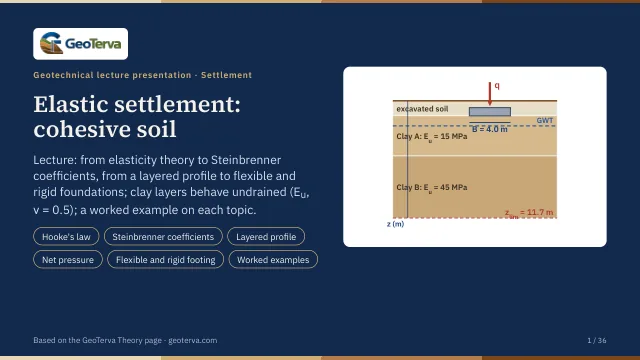
The mechanism, the derivation, the equations and the figures of this page, in teaching order. Every slide links back to its chapter.
1Scope
The consolidation of the clay — the settlement that follows as the water leaves — is computed in the Consolidation module; the Settlement 2D module adds the two over one profile: consolidation plus immediate settlement in the clay layers, immediate settlement in the granular ones. Granular soils have their own module, Elastic Settlement — Granular soils.
2Theory of elasticity
Under a perfectly flexible foundation carrying the net pressure qnet, Hooke's law gives the vertical strain and its integral the settlement (the source):
The stress increases are those of a homogeneous elastic half-space (Boussinesq). Because the lateral stresses depend on ν, the strain — and the settlement — depend on both E and ν.
3Steinbrenner's influence factors
For the corner of a uniformly loaded rectangle the integral has a closed form (Steinbrenner; the source):
A1 = ln[(m′ + √(m′² + 1))·√(1 + n′²) / (m′ + √(m′² + n′² + 1))] A2 = m′ / (n′ √(m′² + n′² + 1))
with m′ = L′/B′ and n′ = z/B′ (B′ the shorter side of the corner rectangle). The centre of a B × L foundation is the corner of four rectangles B/2 × L/2: α = 4, B′ = B/2; its corner is the corner of the whole rectangle: α = 1, B′ = B. Any other point is the signed sum of the four rectangles that have a corner at it. For a strip (m′ → ∞): F1 = ln(1 + n′²)/2π, F2 = (n′/2π)·tan−1(1/n′); at the edge α = 2, B′ = B. The engine evaluates the formulas directly.
4Layered profile
A layer between the depths ztop and zbottom below the foundation level contributes the difference of the half-space solution between the two depths, with its own E and ν:
This is the integral of Hooke's strain over the layer with the stresses of a homogeneous half-space — exact for that assumption, so the result does not depend on the slice thickness Δz (the slices only serve the tables and the fields). It replaces the weighted average modulus of a single-layer formula. When the stiffness of a layer grows with depth, split it into several layers.
5Cohesive layers
| Layer | Behaviour | E | ν |
|---|---|---|---|
| Cohesive (clay, silt) | undrained — no volume change right after loading | Eu = β · cu | 0.5 |
β depends on the plasticity index and the overconsolidation ratio, from a few hundred to about 1500 (the source). With ν = 0.5 the shape factor Is = F1 + (1 − 2ν)/(1 − ν) · F2 reduces to F1, and the factor (1 − ν²) is 0.75. A layer of clay is split into several when its stiffness grows with depth.
6Net pressure
The excavation removes the effective overburden at its base (the water table is unchanged). With one modulus for unloading and reloading, the elastic rebound of the excavation is recovered on reloading, so the net pressure governs the immediate settlement. A net pressure at or below zero produces no settlement (a negative value is an elastic rebound).
7Depth of the settlement calculation
The strain is summed down to the calculation depth zlim: either the influence depth, where the Boussinesq stress increase under the centre falls to p · q (10 % is the common choice; z′ ≈ 2.09 B for a square, 2.55 B for L = 1.5 B, 2.92 B for L = 2 B, 6.34 B for a strip), or the bottom of the profile, which models Steinbrenner's layer on a rigid base. When the profile ends above the influence depth, its last layer is taken to continue down to it.
8Flexible and rigid foundations
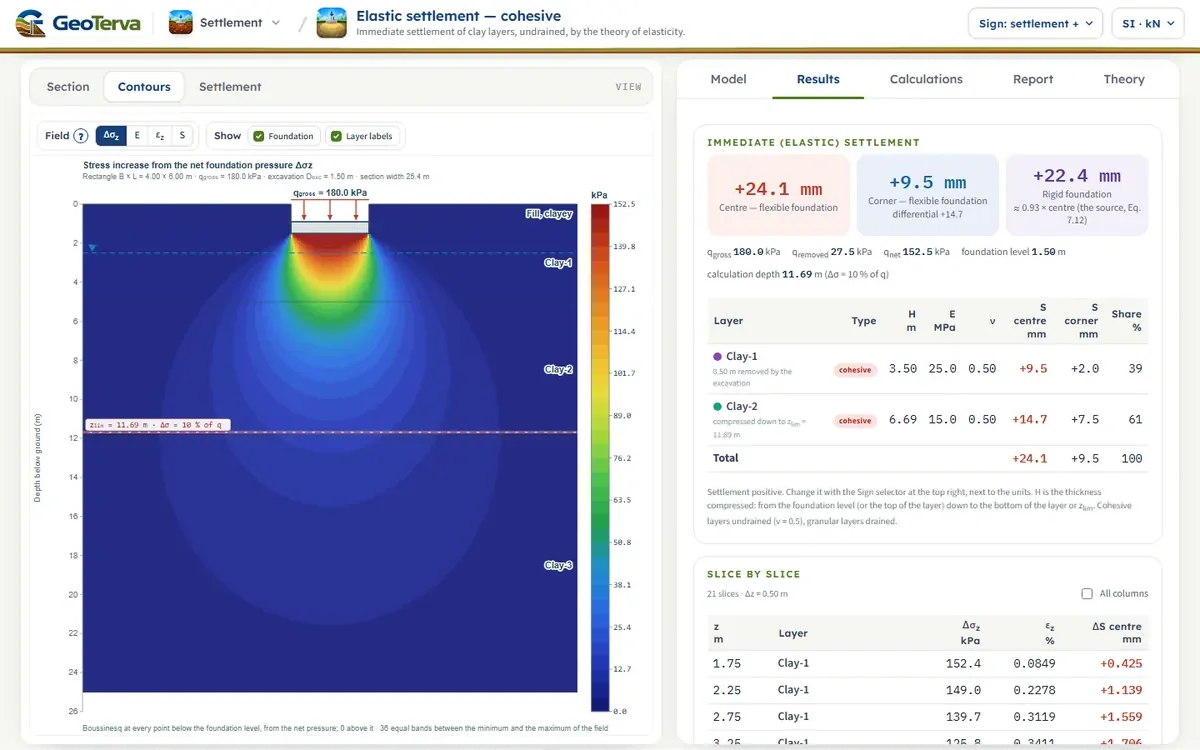
The formulas give the settlement of a perfectly flexible foundation: largest at the centre, smallest at the corner; their difference is the differential settlement of the flexible foundation. A rigid foundation settles uniformly, by about 0.93 times the flexible centre (the source).
9Embedment
The depth factor of Fox reduces the settlement of an embedded foundation with a depth factor If of Df/B, B/L and ν (the source). The module takes If = 1 — no reduction, on the safe side.
10Colour-band fields
The Contours and Settlement views paint a quantity over the section through the centre in colour bands (the legend gives the value at every third boundary): the Boussinesq stress increase of the net pressure, the modulus of the layers, the vertical strain and the settlement S(z) of a point at that depth — the compression of the soil between it and zlim. Strain and settlement use the same slices, E and ν as the results, with Steinbrenner's factors at the point, so the value at the foundation level on the centre line is the settlement of the results.
Classes for the deformation fields. Settlement, heave and strain are largest under the load and small at depth. With equal bands the whole lower part of the section would fall into the first band and the picture would read as if the movement stopped just under the foundation. These fields are therefore painted in classes with the limits 1 · 1.5 · 2 · 3 · 5 · 7 × 10n, from 1/300 of the maximum up, with the colours spread over the classes, and every limit is written in the legend. The stresses, the modulus and a net deformation that changes sign keep the thirty-six equal bands.
11Sign convention and assumptions
- Settlement positive. The selector next to the units in the header switches the display to the convention in which the vertical displacement is positive upward (settlement negative) — in the results, the tables, the drawings and the report; the engine, the derivation in the Calculations tab and the strains and stresses (compression positive) stay classical.
- Foundation level = excavation base (ground surface without an excavation); uniform pressure on a perfectly flexible foundation.
- Stresses of a homogeneous elastic half-space in every layer (with that layer's ν).
- Every layer is cohesive and settles undrained (Eu, ν = 0.5).
- No embedment correction; rigid foundation ≈ 0.93 × flexible centre.
Every assumption that applies to a model is listed with its results (Warnings and assumptions).
12Outside the scope
- Consolidation and secondary compression of the clay — Consolidation module; the sum with the immediate settlement — Settlement 2D module.
- Granular soils — Elastic Settlement, Granular soils module.
- Empirical sand methods (Schmertmann's strain influence factor, SPT- or CPT-based charts) and the Mayne & Poulos modulus increasing with depth.
- Foundation stiffness between flexible and rigid, soil–structure interaction, finite elements.
13References
- Das, B.M. (2016). Principles of Foundation Engineering, 8th ed. Cengage.
- Steinbrenner, W. (1934). Tafeln zur Setzungsberechnung. Die Strasse, 1, 121–124.
- Fox, E.N. (1948). The mean elastic settlement of a uniformly loaded area at a depth below the ground surface. Proc. 2nd ICSMFE, Rotterdam, 1, 129–132.
- Bowles, J.E. (1996). Foundation Analysis and Design, 5th ed. McGraw-Hill.
- Duncan, J.M. & Buchignani, A.L. (1976). An engineering manual for settlement studies. University of California, Berkeley.
- Kulhawy, F.H. & Mayne, P.W. (1990). Manual on Estimating Soil Properties for Foundation Design. EPRI EL-6800.
From theory to your own design
Find the elastic settlement of your own foundation in minutes
- The settlement at the centre, at the corner and for a rigid foundation
- The share of each layer
- Colour bands of stress, strain and settlement
- A clean calculation report, saved as a PDF. Online: nothing to install, no dongle, on a phone, a tablet or a PC